Saturday, August 7, 2021

ASSASSIN'S ORBIT by John Appel

 Thanks to Netgalley for an e-ARC of this title. As another disclaimer, John Appel and I have overlapping social circles. I've played one-shot RPG sessions with him in the past. While that doesn't necessarily influence my impression of the story, it did prompt me to read it.

For what it is, Assassin's Orbit is a fun read. It's a space opera thriller about an older female crew of private investigators and mercenaries. There's a lot of action: space battles, shoot-outs, and criminal investigation abounds. 

I love the representation that the book presents. There are numerous human cultures that have developed, and the reason for the exodus from Earth was well-conceived. Props to John for creating such a vibrant world!

I did have some difficulty reading through the book: and mainly that was because of misleading marketing. If you look at the Simon and Schuster page for the book, the hook line is: "Golden Girls meets The Expanse with a side of Babylon Five." I really dug that description! It gives a really particular, character-centric vibe.

I loved the idea of Dorothy, Rose, and Blanche kvetching with G’Kar and Mollari in the Rocinante's galley. To me, it sounds like a Becky Chambers novel with a bit more conflict in the plot. Similar to what Vivian Shaw did for urban fantasy in her Greta Van Helsing series. 

There are great moments of characterization, and even a few humourous moments squeezed into the descriptive language. But it's not at the level of expectation that tag line gave. Marketing matters.


In an interview, Appel is asked to describe the book in five words. His description is a bang-up summarization: "Old women space competence porn." That gives me a much better idea of what the book is, and I still would've gone for it. 

Thursday, October 10, 2019

Space Opera September Wrap-up!

I found myself participating in a Goodreads book challenge: Space Opera September! Here's the introductory video:

 
It was a ton of fun to do. Driven by a desire to "catch them all,"  I finished all four books. I also hit all four stretch goals.

Monday, January 14, 2019

Children of Time by Adrian Tchaikovsky

At first, it’s easy to discount Adrian Tchaikovsky‘s first science fiction novel. After all, best-known fantasy series (Shadows of the Apt) has a very singular theme that has made him well known: insects. And, to a certain regard, Children of Time, continues the motif.

Spiders… in… Space!!!

Well, not in space.  They’re on a terraformed planet,  the accidental consequence of a bioengineering project. The reader witnesses the evolution of the new sentient race. Their early days are as hunters, morphing over time to a space-age society.

The other half of the story focuses on the Gilgamesh; an ark ship carrying the last vestiges of the human race. Faster-than-light travel isn’t a part of this world, so the voyagers go into stasis. Members of Key Crew awaken every so often to make sure the ship is running smoothly. Of course, things go off the rails, and it’s the fault of the people. Per usual.

Tchaikovsky’s prior work has  been  as a fantasy writer. That serves him in good stead for this volume, particularly for the spiders’ culture.  Evolutionary biology goes into the background of the story. Bit it’s easy to see that the society he presents is the effort of a cracking good world-builder. I itched to skip over the human chapters, only to focus on the more creative work he did with the spiders. But doing that would have been detrimental to the strength of the story.

I’m giving that half too little credit. The Gilgamesh portions were as good. But in a different way. Thinking about how humanity will end is bittersweet. It’s tough to see the race hasn’t moved past its tribalism and obsession with mortality.

There’s a great phrase near the end of the story: “a tyranny of priorities.” The drama between the two groups is driven by their own survival needs and hampered by a lack of communication. The way that they realize that the tyranny can fall away is a bit of a slick trick that comes at the eleventh hour. It’s a good solution, but it feels like Tchaikovsky had a clever idea that he couldn’t quite follow through on.

My biggest gripe about the story is the main human character, Holsten. He’s an interesting academic, and provides a great viewpoint. But he lacks agency. He’s there as a reader’s avatar, and he doesn’t grow too much as a person. You could argue that his static nature is symbolic of humanity as presented. Which is a sad commentary, but important.

That  said, Children of Time is an excellent book with a lot of great, entertaining ideas. I highly recommend it!

Wednesday, December 19, 2018

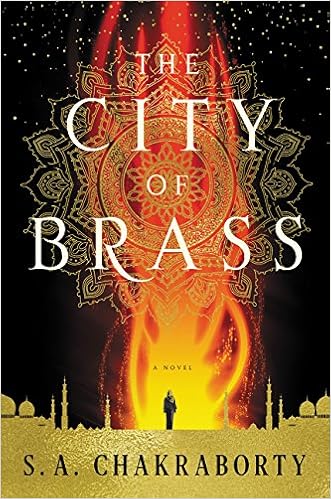
City of Brass by S. A. Chakraborty

Nahri is a young, street smart con artist living in Cairo. The Ottoman and French Empires are contesting the land, meaning that there are all sorts of marks for her fortune telling business. 

But Nahri has other skills, too. She has a knack for healing the sick. If she hears any language, she can understand and speak it. Her own native tongue, Divasti, is completely different from anything else others speak. 

While participating in a Zar exorcism ceremony, Nahri decides to use Divasti to add some exotic flair. Little does she know that it will get the attention of a daeva and a ifrit. Plunged into a world that she previously thought was myth, Nahri has to navigate her place in the new world. 

Overall, this was a fun book to read. I've had it near the top of my queue since April, but felt the time was right just a few weeks ago. I took it with me to a major convention, PAX Unplugged. I found the story engaging enough that I was stealing time before gaming sessions to enjoy it! It certainly made standing in the registration lines a lot more bearable. 

Nahri is a well-rounded character, as are the supporting cast. But the setting is definitely the highlight of the book. It's fun to read a story that takes its cues from Islamic culture. Chakraborty does a great job of making the world details come to life. Because the general public lacks a lot of knowledge, the book has to do a lot of world-building, so the pacing can be a bit slower at times. But for seasoned fantasy readers, that's not an impediment. Many would see it as a feature rather than a bug. For those looking for more consolidated detail, there is a glossary at the back of the book.

If I were to compare City of Brass to another book, the choice that comes to mind is Harry Potter and the Sorcerer's Stone. Nahri and Harry share some interesting parallels. They're both young, destitute people with special abilities. They're both orphans, and they both have an unlikely mentor (although Hagrid and Dara have very different personalities). The similarities are superficial, granted, but there's enough parallels that it really piqued my interest. 

Honestly, I think that's a sign that S.A. Chakraborty was trying to grow her writing chops. City of Brass is a debut novel, and a rather ambitious one at that. Plotting isn't an easy task to learn, so keeping the plot familiar acts as training wheels while the author is learning. If the plot were at the same level for further volumes, I'd grade harder.

As it is, though, City of Brass is an entertaining read with a vivid setting and solid plot. The characters are fairly likeable overall, with solid motivations and intentions. I'm really looking forward to the next book of the series, The Kingdom of Copper. That'll be released next January.

Tuesday, December 18, 2018

The SpaceTime Reading Challenge

As I looked over the review selections I made so far, I noticed something. It's been heavily skewed towards fantasy. Nothing wrong with that; I enjoy fantasy novels quite a bit. But I also really enjoy science fiction. 

So I decided to even out the scales a bit. So I found an online challenge specifically devoted to science fiction: the SpaceTime Reading Challenge! It was nice to find a challenge that was specifically focused on science fiction.

The challenge runs from 1 January to 31 December, 2019. Currently, there are four different participation levels.
  • 5 books: Planet hopper
  • 10 books: Interstellar explorer
  • 20 books: Galactic navigator
  • 40 books: To Infinity and Beyond
I've settled on the Galactic Navigator level. I want to leave some open room in my schedule for other books, and perhaps another challenge. I had a lot of success with the 2018 r/Fantasy Book Bingo challenge, and I may want to do that again.

Here's my potential SpaceTime list:
  1. Grass by Sherri Tepper
  2. The Wrong Stars by Tim Pratt
  3. Quantum Magician by Derek Künsken
  4. The Poison Master by Liz Williams
  5. Dying of the Light by George R.R. Martin
  6. Skyward by Brandon Sanderson
  7. Nova by Samuel R. Delaney
  8. A Big Ship at the Edge of the Universe by Alex White
  9. The Ark by Patrick S. Tomlinson
  10. The Forever War by Joe Haldeman
  11. A Red Sun Also Rises by Mark Hodder
  12. Embers of War by Gareth L. Powell
  13. Escaping Exodus by Nicky Drayden
  14. Noumenon by Marina J. Lostetter
  15. Tekwar by William Shatner
  16. The Quantum Thief by Hannu Rajaniemi 
  17. The Empress Game by Rhonda Mason
  18. Downbelow Station by C.J. Cherryh
  19. A Fire Upon the Deep by Vernor Vinge
  20. Mistworld by Simon R. Green
This may change over time. I don't typically think about what I want to read until I'm done with one book. So I may find myself mixing up the list a bit. Also, I probably won't go in the numerical order listed, for similar reasons.

As I finish and review each book,  I'll add a link to the title.

Wednesday, December 12, 2018

In the Vanishers' Palace by Aliette de Bodard

The world has been decimated by the Vanishers -- a race of aliens who came and exploited the world and then disappeared.

Now, humanity lives in the vestiges of a world created in their image. Life isn't easy. Due to the power vacuum the Vanishers left behind, society has fractured down into small villages. Unknown, new diseases ravage the population.

Fortunately, there is one individual who is helping humanity. The Vanishers left one of their servants behind: the dragon Vu Côn. She walks the earth, trying to make things better for those left behind. Normally, if she helps heal someone, she takes them as her own. Instead of complying to this practice, Yên's village makes a switch. They trade Yên, a failed scholar, instead.

Fortunately, Vu Côn has need of a scholar. She has two children at home in the Vanishers' palace. A scholar is exactly what she needs. So Yên goes to live in the Vanishers' Palace.

On her blog, de Bodard described this book as a story she wrote for herself. She had decided to write a f/f re-telling of Beauty and the Beast, with a mythical Vietnamese setting. It really works perfectly, for several different reasons. First, you can tell that the story is a labor of love. From the subject matter to her decision to self-publish, de Bodard made choices that allowed the story to be what she wanted it to be.

I really admire that decision. We got a lovely little work that feels familiar and fresh at the same time. Also, I think it does a great job of being daring. If de Bodard had focused on writing a book that would have been friendly to publishers, the work would not have been so strong to it's vision.
As I was reading, I kept confronting a singular question. What does the word "vertiginous" mean? It was used at least six different times to describe the palace. Normally, I can understand an unfamiliar word from the story's context, but this time I was puzzled.

At first I thought it was talking about a deep, watery green. Which shows a bit of personal prejudice. I tend to associate Asian dragons with water, Probably because of sources like Chinese dragon mythology. Miyazaki's river dragon, Haku, from Spirited Away also influences my perspective.

The word actually has a more apt meaning. According to Merriam Webster, it's characterized by vertigo or dizziness. It can also mean inclined to frequent, pointless change. 

This definition makes a lot of sense with the description of the Vanishers: an alien race who was  fearsome and unfathomable. It was a nice twist on expectations. I was expecting a fantasy based in mythology, but the Vanishers are more akin to the pantheon of the Cthulhu Mythos. 

Vu Côn, as the Beast analog, was a particularly fascinating character. She was a servant of the Vanishers that got left behind. She feels obligated to the destroyed world that her overlords left behind. Instead of being a Beast trapped by a curse, Vu Côn is motivated by a sense of responsibility. She is seen as a Beast because her motivations aren't clearly understood. 
 
Her lot is particularly poignant when you think about the way people treat her. Afraid of the dragon, they don't treat her like a person. They see her as someone to be feared. Vu Côn doesn't want to be ostracized in this way, but she accepts it as a form of personal atonement for the deeds she did. 
 
In a similar way, Yên is an outsider. She is interested in academics, but isn't good enough to go to the academy. She can't find her purpose in the village, but feels tied there by familial obligation. It is only with another outsider that she can accept who she is and find fulfillment. 
 
In the Vanisher's Palace isn't a long read, but it is well done. If you're looking for a different take on fairy tales, or for a lesbian love story with a great setting, I highly recommend it.

NOTE: I purchased this novel via pre-order. But I also received a copy of it through NetGalley.

Thursday, December 6, 2018

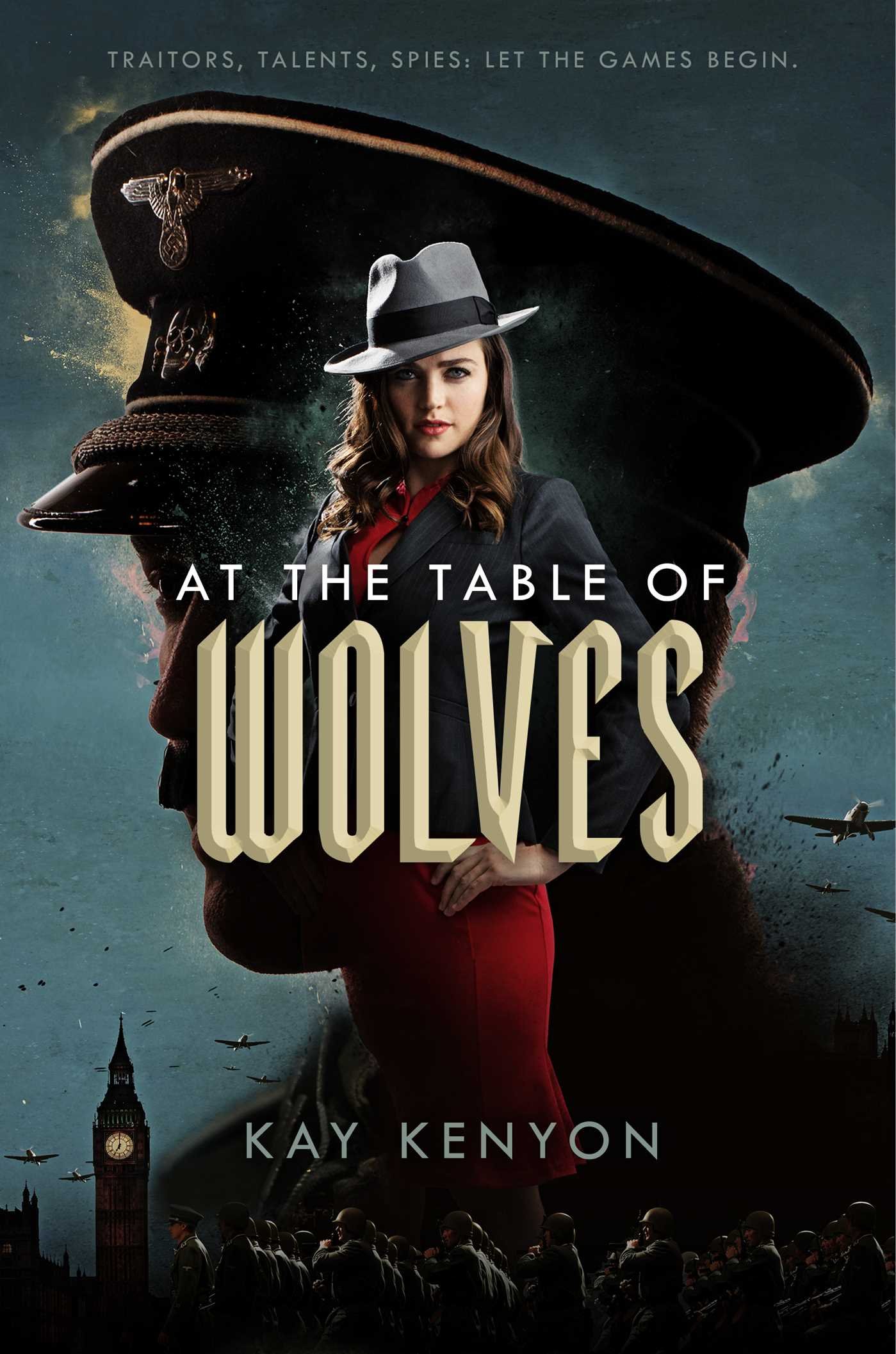
At the Table of Wolves by Kay Kenyon

In 1936, Germany's invasive streak is starting to become more noticeable. Weeks earlier, Rhineland was taken. While most of Europe is questioning what to do, England hasn't officially taken a position. But, of course, their espionage teams have begun monitoring for a Jerry invasion. 

Since the end of World War I, a new resource is available: Talents. It's not entirely clear why, but supernatural abilities have begun to bloom, sometimes in the most unexpected people.

Kim Tavistock is one of those people. A British/American dual citizen, she has returned to her father's homeland.  Her career as an investigative reporter in America has collapsed, and she's looking for a way to put her skills to use. Her Talent is spill; people share private, personal information with her. Just the perfect ability for a spy to have.

This book has a great story, but it's far less action-packed than what I expected. I think that was due to the cover. It's got an imposing, tense air. Those planes flying across bring up mental images of the bombing of London. The portrait of Kim is reminiscent of Hayley Atwell as Agent Carter. The promo copy on Simon and Schuster's website actually name checks Agent Carter along with Tinker Tailor Soldier Spy. I was expecting more behind-the-lines burglary and espionage flavored by superpowers.

Instead, the book has a high amount of social interaction, making the le Carré comparison more apt. Many of the important scenes are set in high society countryside weekends and fancy luncheons. The crux of information gathering in the story is gossip. Due to her Talent, Kim excels at this. Kenyon makes a fascinating choice, though, by making Kim uncomfortable with her ability.  She has no issues with her former role as an investigative reporter; but she wants people to like her for who she is. Kim doesn't want to betray people's trust, even unintentionally.

A major theme of the book is the dangers of a spy's life. By dint of the craft, one can't share information with those close. Kim isn't the only one who faces this issue. Her father, Julian, is a spy as well. Unlike Kim, Julian is working for H.R.M.'s government. The conflict between these two spies is at the crux of the story. They've been estranged for years. Now, both want to develop a closer relationship with each other. However, they each feel their secrets are too insurmountable. Kenyon is familiar with the theme of daughter/father conflict. It's a huge driver in her epic science fantasy series, The Entire and the Rose. It's not surprising to see her return to it in The Dark Talents.

One thing I particularly appreciated about At the Table of Wolves was the examination of modern events of the time. It's easy to look back at WWII and draw clear, black-and-white ideological lines. Kenyon captures the confusion of the time, though. A lot of people around the world thought that Hitler wasn't so bad. Even King Edward VIII (who reigned from January to December 1936) had pro-Nazi tendencies. After his abdication, Edward and his wife actually visited Hitler in Germany, and there were numerous rumors. Early in the book Kim mistakenly believes that her father is actually a supporter of Hitler, describing him as "something of a Nazi."

While the book is largely well done, there are a few flies in the ointment. The largest is the written use of accents in the story. The Tavistocks, being landed gentry, have servants. Their accents are thick and hard to read. It comes down to personal taste, but I have a hard time reading accents as they're written. It looks awful on the page. Also, it immediately hearkens back to the first time I saw it done -- the moles of Redwall. If it didn't make me think immediately of a children's book, I may be more lenient.

Overall, though, the story is breezily written, and is easy to follow. As mentioned before, the intrigue is a bit low-key compared to expectations, but it's very well paced and enjoyable.

Wednesday, November 28, 2018

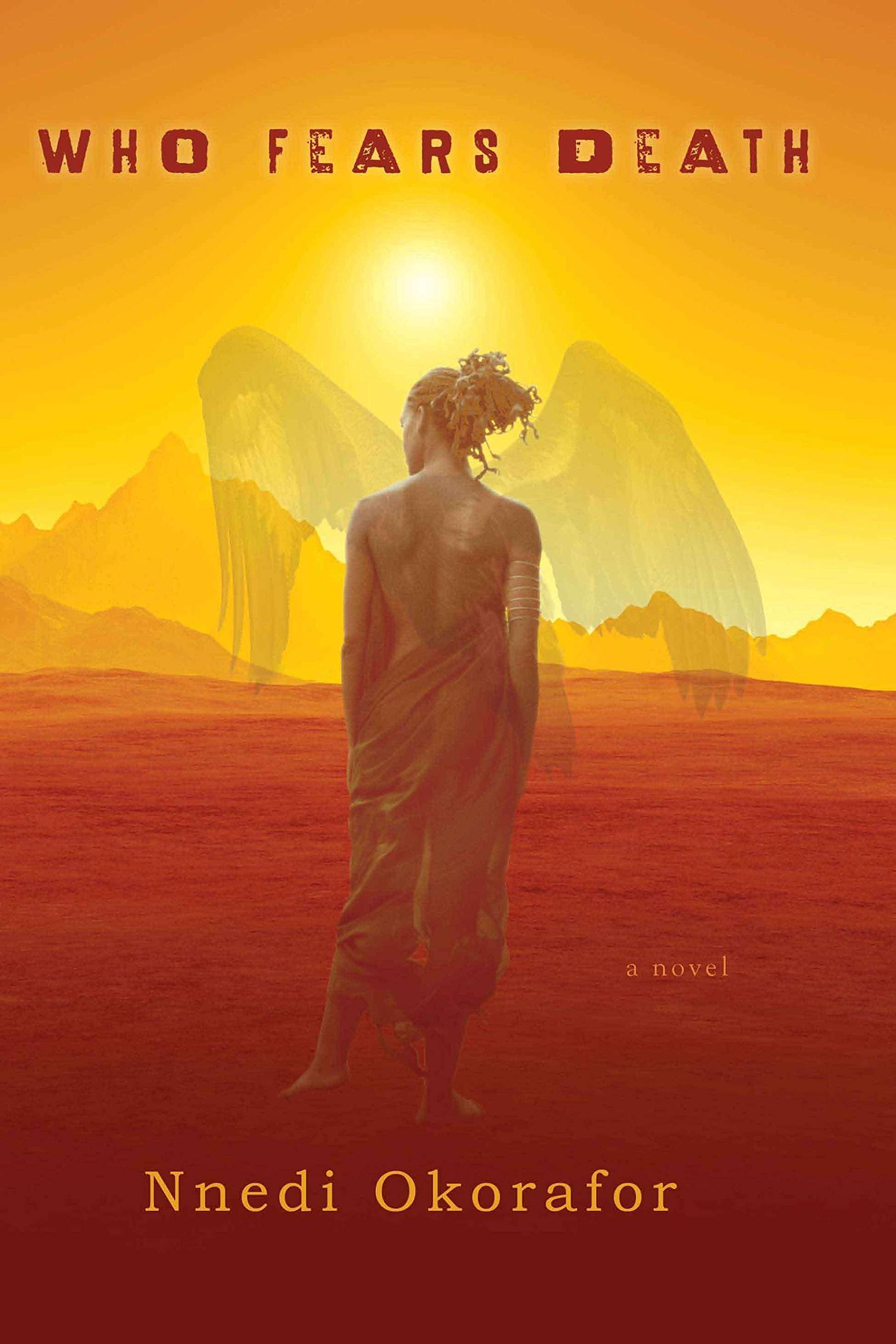
Who Fears Death by Nnedi Okorafor

Who Fears Death is the story of a young woman named Onyesonwu.  It takes place in a future, post-apocalyptic Sudan. Magic is real, and  coexists with legacy technology.

Onyesonwu is a child of interracial rape, an Ewu.  As a result of this heritage, her skin is the color of sand and she  immediately stands out in her culture. Her name translates as "who  fears death?"

The story is a rather character-driven  journey. The stakes are incredibly personal. Onyesonwu's mother's people  are the Okeke. The Nuru, her father's people, are invaders who have  subjugated many Okeke villages.

Okorafor pointed to this article on the Darfur crisis as inspiration. Onyesonwu's father, Daib, is a particularly nasty character. He acts as the book's main villain. For much of the story, she tries to reject that he is her father.

A large part of the story deals  with confronting her place in society and what it means to be Ewu. As she grows older, Onyesonwu  sees herself as a burden on her mother and stepfather. It's a struggle  that she pushes against throughout the entire story.

She  tries to follow her village's customs, even those her parents  disapprove of.  As an attempt to  increase her social standing within their community, . This creates a  temporary rift between her and her parents. But it provides a strong  bond with the others undergoing the ritual -- an important element to the story.

I liked this book quite a bit. I'm particularly biased towards first-person novels. In that regard, Who Fears Death  was already staged to meet my taste. Much of the book is in the first  person, from Onyesonwu's perspective. I loved getting into Onyesonwu's  views of the world. It was immediate, tense, and immersive.

It  is revealed that Onyesonwu is telling the story to a transcriber. so it becomes questionable how accurate the narration is. Which is great, because I like unreliable narrators, too. It  also changed the genre of the story from memoir to possible gospel.

The  ending left me feeling like Onyesonwu left an indelible change on her  world. She could be a possible messiah figure. It ended with enough ambiguity to  let the readers draw their own conclusion. But I would love to see how  Onyesonwu affected the two cultures presented in the future.

This  was Nnedi Okorafor's first novel for adults. She had written several  young adult novels before this one. She does a great job with the tone  of the book. I loved how it sucked me in with the beauty of the prose.  The chapter length is very well done. They read almost as well crystallized short stories.

While  this book was amazing, I wouldn't recommend it to everyone. The content  could definitely make some squeamish. I felt uncomfortable during certain portions. Particularly because I was reading out in public.

I realize that caveat is a large one for many people. But it is a good story that shines a light on feeling like an uncomfortable  in society.  Now more than ever, that's an important factor to think  about. If you are all right with the uncomfortable aspects  of the story, I highly recommend Who Fears Death.

Wednesday, November 21, 2018

Swordspoint by Ellen Kushner


Swordspoint, published in 1986, bills itself as a "melodrama of manners." According to a little internet research, it's a foremost work in the mannerpunk subgenre. Mannerpunk hails back to the regency era, and focuses on social niceties in a fantasy world.

Think The Importance of Being Earnest, but there could be dragons and wizards.

Swordspoint is set in the fictional town of Riverside. The city used to be a monarchy, but now a council of nobles preside. The river bisects the town. The upper crust is on one side, the commoners on the other.

A major factor in the politics of the city is the duelists. Mercenary fencers take commissions from nobility. Sometimes, these are for general non-lethal performances. Weddings, parties, the like. Other jobs are law sanctioned contracted hits. The nobility use the duelists to fight a highly codified proxy war among themselves.

I enjoyed the relationship at the center of the story. Richard is a duelist in high demand, and Alec is a scholar from a noble past. They're are interesting characters with a lot of life. You can tell that Ellen Kushner worked hard to develop their romance in a real, relatable way.

The book's title comes from the following epigram: "Every man lives at swordspoint." This means that every one has something in their life that makes them susceptible. It's a great foreshadowing. One particularly odious nobleman tries to use Alec as leverage over Richard. The swordsman complies, and then wreaks a particularly nasty revenge.

While there was a great deal to enjoy in the story, I did find it a rather mixed bag.

Pacing was a bit of an issue. I had a hard time paying attention to the parties and the social fetes of the upper class. While they expanded the world of Riverside, it wasn't easy to like any of the members of nobility. They were rather flat -- as if they were scenery pieces rather than real people. I would have enjoyed it more if there weren't such a wide array of parties and fetes. Less superfluous exploration of the higher class would have tightened up the story.

I listened to this as an audio book. The author narrated it, with help from various actors. There were also sound effects and musical clips. It won an Audie Award in 2013, so I had high hopes for the quality of the production.

Unfortunately, I found it fell short. The sound effects and music were more-or-less random in execution. Only some of the characters had different voice actors. Also, some of the lines awkwardly shift from the narrator to the actors mid-break.

I would have enjoyed the book more without the "enhancements." If they created a full audio-drama, that'd be wonderful. It's one of my favorite mediums. But this amalgam of book and audio drama didn't work. It was an exercise in exasperation.

Ellen Kushner did a fine job narrating the story. If the production had maintained that, it would have been a far more entertaining work. The extra fluff only made it harder to listen to.

Final word, Swordspoint is a very serviceable work that could have been even better.

Tuesday, November 13, 2018

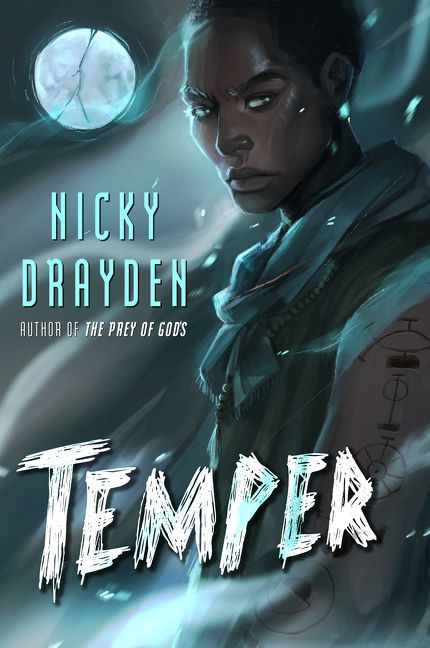
Temper by Nicky Drayden

Temper is about twin brothers, Auben and Kasim Mtuze. Set in a fictional analogue of southern Africa, they live in a society that is made up of primarily twins. As a coming-of-age ceremony, these twins are assessed and assigned a mixture of the seven vices.

Normally, it's common for the twins to split along a three to four ratio. Sometimes, it can be five to two. The Mtuzes are rare in that Auben has six and Kasim only has one.

Kasim has embraced his bad-boy lifestyle. He flirts with the girls. Classes are meant to be missed, right? Also, he isn't afraid to supplement his lifestyle with a little bit of theft.

But, as the year turns, Auben starts to hear voices. They're pushing him to go beyond petty  fun-seeking and move into more serious misdeeds. Also, he's starting to crave the taste of blood.

Overall, I really liked Temper quite a bit! This was Nicky Drayden's second effort, and I'm going to add her to my category of "to-read-upon-release."

First, I loved that the story was a standalone. There's nothing wrong with a series. But, sometimes, looking at the book store's shelves, I think that the stand alone speculative fiction novel is a lost art. It's nice to find a story that fits into less than four hundred pages.

I also liked the social structure of the world. Peoples' social status depended on how many vices they had. Since Auben had six, he wasn't looking at the rosiest of futures. Kasim was looking at the reverse. He expects to climb to a respectable position on the social ladder. Auben, though, can expect to live in a ghetto called a comfy.

Also, I liked the idea of a society of twins. There's a very specific world building reason that this happens that I won't get into here. But, in addition to the male/female paradigm, the twin effect has added the kigen gender, which was an interesting thing to think about.

The world of the story is going through an intense debate about religion and secularism. The two sides have very strongly drawn boundaries. Also, mechanical devices are verboten, due to cultural exploitation from machine-using conquerors.

The Mtuze's mother is strongly secularist, and she's raised her boys to be such as well. When they choose to explore religion as a means of understanding what's happening, she reacts strongly.

I love the sense of humor in the story. Auben revels in the funny. His uncle-in-law, Pabio, illustrates not-safe-for-work "childrens" books, such as an octopus with mouth-herpes. There are other examples, too, but some of them give away a bit too much of the story.

I was a little less thrilled with the use of language in the book. It's written in the first-person, present tense. No issues with the first-person voice -- I love it in general. It's just a touch jarring to read at first. Whenever I came back to the book, it took a few minutes to get back into the swing of the text.

Also, the chapters were really long. It was sometimes hard to find a good stopping point, particularly when I started dozing off in bed. If the chapter subsections had been a bit more clearly labeled, it would have been easier going.

Overall, though, those are some minor nitpicks. I highly recommend this for people interested in reading fantasy set in Africa (something sorely lacking at the moment), and also people interested in drama between family members.

Wednesday, November 7, 2018

The Healer's War by Elizabeth Ann Scarborough

I thought the book did a good job of humanizing war. While working in the hospital, Kitty divides her time before treating American soldiers and Vietnamese civilians. Scarborough worked hard to make the Vietnamese characters seem real, well-rounded people.

Later, during the jungle portion of the story, Scarborough shows how the ordinary people are trapped. In order to just survive, they have to keep both sides of the conflict happy. It's not an easy job, and it takes a huge toll.

I liked the magic The magical talisman doesn't help Kitty "win;" she doesn't gain some kind of power that allows her to overcome her challenges. Rather, it helps her see what lies underneath the surface of those around her.

The first-person narrative of the book is vital -- if it were told in third person, the story would not have been quite as effective. Also, as a woman, Kitty didn't have to go to Vietnam. She could have found plenty of work in an American hospital. But she took a commission voluntarily because she wanted to help. I think the book would have had a much less vibrant perspective if it were through the lens of a drafted serviceman or even a male nurse.

I think this is an important book, particularly because it shows the personal effect of battle on people. It thinks about who is involved -- the "good guys," the "bad guys," and the people just caught in the middle. It also ends well, showing Kitty struggling with PTSD and finding a way out.

It's especially important because the genre tends to glorify war to a certain extent. I wish there were more stories like this. I'd recommend this for people who are looking for a different kind of look at the violence people inflict.

Wednesday, October 31, 2018

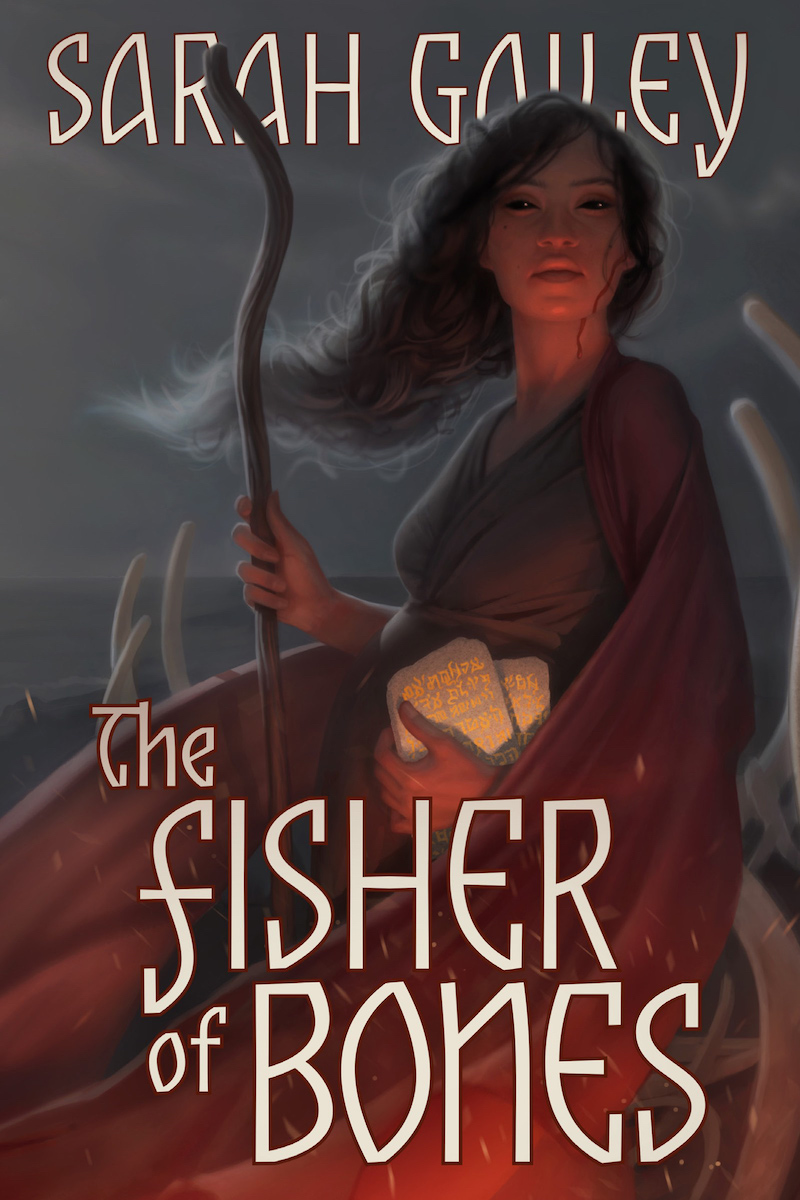
The Fisher of Bones by Sarah Gailey

NOTE: You can read Fisher of Bones for free on Fireside Magazine.

This is a story I can't stop thinking about it. Fisher of Bones tells the story of a small group of people who are looking for their Promised Land. 

The viewpoint character is their Prophetess, recently appointed by the previous Prophet (her father) right before he dies. She has to keep the fractious group united until they reach the Promised Land, and the job proves difficult.

I loved this story for several reasons. The first was the format. It's a novelette written as a series of short vignettes that are packed with character detail and emotional tension. They draw you through each chapter all the way to the ending. Because it's so short, the world building is dense. There are very few superfluous words.

A lot of other reviews I've seen has asked for more details. But I don't think more is necessary. After all, the Gods are not the driving force of the story. The act of living in the tension of community is the true focus. The Gods are, in a horrid sense, a Macguffin.

Faith in the Gods and their Promised Land drives and cements the community. The tribe wants to believe, but they have doubts. Since the Prophetess is the voice of the Gods, she receives the brunt of the angst her people are feeling. 


As is often in life, faith in this story leads to a place that's dark and scary and mysterious. If the Gods were revealed in more detail, the mystery would be destroyed.

Also, I loved that the Prophetess struggled so much with faith. Often, religious leaders have to put on a brave front for the rest of their group. Many of them have the most doubt, though. I thought this was a great aspect to the Prophetess, and loved seeing how it affected her relationships with her closest family and friends.

All-in-all, a remarkable piece of fiction that speaks a truth that is both real and memorable.

Thursday, October 25, 2018

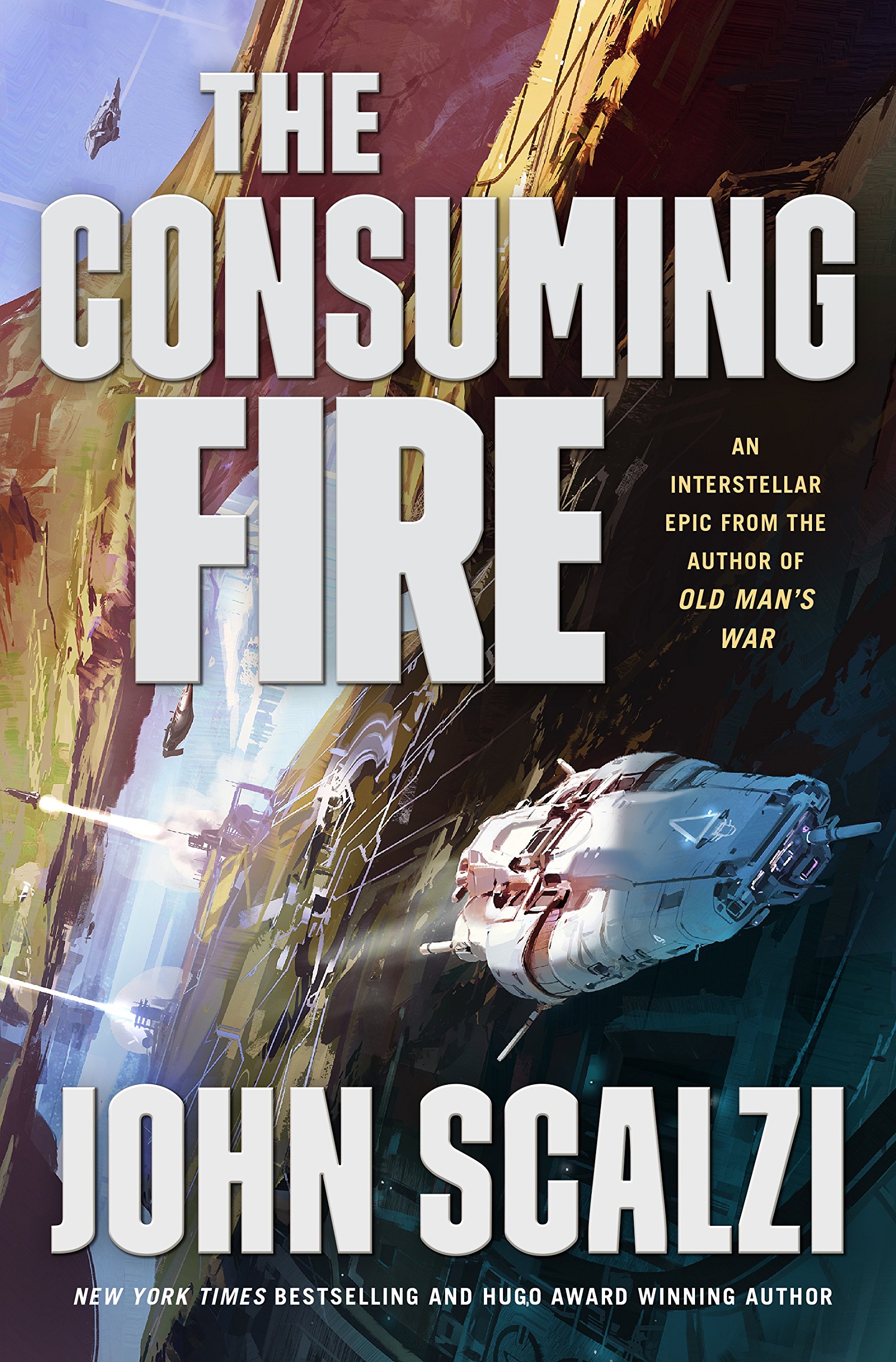
The Consuming Fire by John Scalzi


The story picks up pretty much where The Collapsing Empire leaves off. The three viewpoint characters, Cardenia, Marce, and Kiva return in this new volume.

Cardenia is becoming more comfortable in her role of Emperox and spiritual figurehead. She has decided to move forward with preparing the Interdependency for the Flow's collapse. There is doubt against her from her government, from the Wu clan, and from the church she leads.

Marce has found some new changes in the Flow's collapse. He teams up with another scientist who had been studying the Flow for House Nohamapetan. They determine there could be new, temporary Flow shoals that can pop up. One of these leads to a previously lost member of the interdependency. They convince Cardenia to let them launch an expedition.

Kiva Lagos has taken to the task of dealing with the Nohamapetan's dealings around Hub. Her efforts have turned up some rather elaborate skimming schemes. The Nohamapetan house is less than thrilled with her management of their functions. She also finds love!

There's a lot to enjoy with The Consuming Fire. Just like it's predecessor, it's an easy read that's fun to get into. Scalzi's story-telling is breezy and enjoyable. He keeps the chapters short enough to keep pulling the reader through the story. I found myself toting the book around to different appointments so I could read it in my free time. I loved the exploration aspect in this story. The idea that there's a lot more beyond the Interdependency is both exciting and intriguing.

A big theme of the story is the use of religion as a tool by the government. It definitely follows what Scalzi established previously. The use of religion as a political tool is historically undeniable. From the deification of the pharaohs to the creation of the Holy Roman Empire, history has shown time and again that religion and power go hand-in-hand.

But the way religion is handled is hard to swallow.

Personally, I think religion when properly handled can be a positive force in the world. It can give people a sense of belonging. It can also provide a strong mythology for people to use as a cornerstone for their identity. The brain is a story-making machine, and faith can provide a context for the personal story.

Let me point out: not everyone feels religious faith is necessary, and that's perfectly fine. I think Scalzi was trying to make points about the use of religion by government, not about faith as a whole.

But he doesn't present it in a concrete, understandable way. I don't know the tenants of the Interdependancy's religion after reading this book. I know it's a bit sanitary in practice; i.e., it doesn't normally trend towards the mystical. It promotes being a decent person. But I don't know how the faith actually provides believers with a higher understanding of their place in the cosmos.

The way Cardenia uses the church in her official capacity is an interesting move. She knows why the church was created, and seems to have some qualms about the morality of her role in it. But she doesn't hesitate to use it to prepare people for the imminent disaster. I liked that development; but I wish we could have seen some more personal wrestling with this idea. She makes up her mind to use a religious approach between books, and so we're only really seeing the aftermath.

I also had issues with the way the science was glossed over in the story. In several points, Marce was asked about particular details in the science. And he always said to the layperson that they wouldn't understand the math involved.

I don't typically like hard SF. Space opera and science fantasy are my jam. But I do want some more technobabble in my science fiction. I understand that pacing is a concern, but it doesn't have to be a lot. Just a bit. It's the paprika on the deviled egg.

The characters didn't have a lot of internal drama, either. It's a rather plot-based story. There are some romantic elements. It was easy to see from the last book that Marce and Cardenia would become an item. Box checked. But, for the most part, the characters remained static people. There wasn't a lot of personal growth. Just preparation for the upcoming Flow collapse.

Finally, it doesn't feel like this is a middle book of a trilogy. It feels like book two out of at least a six book story. The overall story moves a bit, but not significantly. I still feel like there's a lot more to learn about this world. That's not a bad feeling; I'm being entertained. I just want more.

The overall length of the book was just over 300 pages. It could have at least 150 more pages. I would have loved to see more world-building, more character development, and also more advancement of the plot. What we got was good, but The Consuming Fire could have been even better.

Sunday, October 21, 2018

The Collapsing Empire by John Scalzi


The Collapsing Empire is the opening volume of Scalzi's latest space opera series. In this world, it is the far future. Humanity has spread to the stars in a vast empire which has existed for a millennium. There has been only one dynasty: that of the Wu family.

Faster than light travel isn't available in the most familiar sense. No hyperspace or warp speed. Instead, starships sail on a space/time current called the Flow. It doesn't take hours or even days to travel; rather, weeks or even months. There are specific points where ships can enter and exit the Flow, called shoals. 

At the beginning of the book, the Empire is in trouble. The Flow is beginning to change. It's no longer becoming accessible to humanity. Some people believe that it's reversing course. Others think something more dire is occurring.
 
According to an interview with NPR, some wondered if the title was a thinly veiled reference to the perceived fragility of the United States. Scalzi pointed out that he was reaching further back. 
In fact I did think very generally about the "golden age" of European exploration, roughly corresponding to the 15th through 17th centuries, in the sense that the empires that rose out of that era were wholly dependent on natural forces (wind, ocean currents, rivers) to move their ships and shape their destinies with regard to trade and exploration. We're so used to having at least some mechanical control of our travel that it's hard to put oneself back into a mindset where travel took months, not hours, and was not always a safe and predictable thing.  
So there was no one particular empire in our past I was borrowing from, but rather, a whole historical gestalt, and then only loosely. Please, historians, don't tell me all the things I'm getting wrong about the European age of exploration! I know. I KNOW.
I loved this approach! I've always found this time frame to be rather fascinating. And the tropes of the Age of Discovery were rather apt for a space opera. For example, trade monopolies. From a historic perspective, the East India Trade Company exerted tremendous power in Great Britain. 5% of all imports came from India, and passed through the Company's control at some point. 

Something similar occurs in this story.  The imperial Wu family is the dominant powerhouse. But they've allowed other nobility members to have their own franchise monopolies. For example, the Lagos family has control of all citrus fruits in the Interdependency.  

Scalzi's trademark snark seasons the story. He's never going to be one of my favorite stylistic writers. In general, I've always found his descriptions generic at best. But his biting sense of humor is a solid compensation. It makes the story easy to read, and I found myself moving through it at a quick clip. 

One area that the humor shines through is in the name of the ships. Scalzi has acknowledged that Iain M. Banks's Culture series were an inspiration. And sometimes a well-crafted homage fits into the tone of a book. Every time I heard about the Yes, Sir, That's My Baby and No, Sir, I don't Mean Maybe it made me smile. 

A word of warning to those who dislike profanity in their stories: this book is heavily layered with them. One character, Kiva Lagos, works in profanity like a proficienct master orator bent towards the obscene. While I found her funny, I can understand why others would easily tire of Kiva's... creative license.

All in all, I'd recommend The Collapsing Empire. It's funny, its easy to read, and it's creative by looking backwards to extrapolate forward. The second book in the series, The Consuming Fire, was a recent release. So expect my thoughts on that soon.

Thursday, October 18, 2018

Perdido Street Station by China Mieville

I enjoyed a lot of Perdido Street Station's parts -- particularly the first half of it. I loved the atmospheric nature of the story. I thought Mieville did a great job of immersing me into the world. I loved the early discussions of chaos theory. I enjoyed finding out about Lin and Isaac's relationship and their professional lives.

And then the story took a left turn. It went from a beautifully written character piece to a monster-hunting story. I don't mind thrillers at all, but I felt the change was too abrupt. Also, it took a far more uninteresting path. The set-up of the story I was interested in was the moral implications of helping a criminal regain what they lost due to punishment. What was delivered, while exciting, didn't have the same potential impact.

Also, I hated the fridging of Lin. It was unnecessary, and it deprived the reader from a really interesting story line. Instead of investigating the criminal side of New Crozuban from an outsider's perspective, her story line is dropped completely until the end of the book. At that point, she's not even given any further viewpoints.

I also find the implicit comparison between Yagharek and Lin unsettling. Yagharek's wings were removed for the crime of rape. Lin's headwings were removed as a way to threaten Isaac. I don't think it was intended, but it feels like the violator and the violated are thematically linked. There's almost a whiff of "Lin got what she deserved" from the association, which is totally not the case. It's a really sour note to end the book on.

All-in-all, I liked the writing and will look for other Mieville books to read in the future. However, I think Perdido Street Station suffers from being a second book. I fully expect that subsequent works will be better executed.

Thursday, October 11, 2018

Midnight Front by David Mack

I really wanted to like this one, but it failed to entertain.

I like the idea of WW2 fought with magic. But The Midnight Front tried to cram in too much. I think this book would have made a better series. There were a ton of characters, and they were all paper-thin. Even the main protagonists and antagonist. A series specifically about these characters would develop the character's motivations more. If they were likeable, I would have been more interested in the story.

There were several big set-piece moments that would have worked well as the climax of the story. For example, the battle of Normandy was the end of the book's second act. It could have easily been the culmination of a novel, especially considering the stakes presented.

Also, I didn't like the magic system in this one. It was one-dimensional and boring. The description of when characters used magic was in the following format: [Something cool] caused by [Specific Demonic Attribute]. The use of magic felt like a GURPS roleplaying game combining WW2 and Warlocks. I wish there were different sources of magic, too. I didn't like that
mages on both sides used demons. I guess I was pampered by Bitter Seeds by Ian Tregillis, where the magic had a more emotionally resonant source AND the Nazis got their powers from a different source than the Allies.

Also, the book doesn't have anything original to say about religion. It's a tired, lazy re-tread that is easy to see for miles off. For a book that has so much to do with the religion-inspired supernatural, it comes off as trite.

All-in-all, a disappointing read. It could have been so much better.