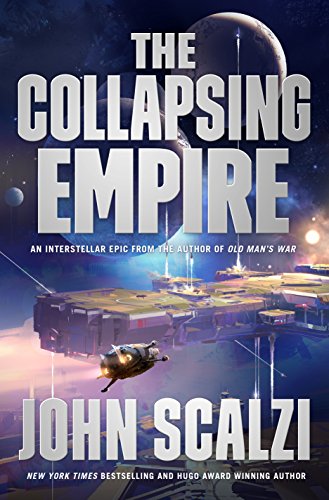
The Collapsing Empire is the opening volume of Scalzi's latest space opera series. In this world, it is the far future. Humanity has spread to the stars in a vast empire which has existed for a millennium. There has been only one dynasty: that of the Wu family.
Faster than light travel isn't available in the most familiar sense. No hyperspace or warp speed. Instead, starships sail on a space/time current called the Flow. It doesn't take hours or even days to travel; rather, weeks or even months. There are specific points where ships can enter and exit the Flow, called shoals.
At the beginning of the book, the Empire is in trouble. The Flow is beginning to change. It's no longer becoming accessible to humanity. Some people believe that it's reversing course. Others think something more dire is occurring.
According to an interview with NPR, some wondered if the title was a thinly veiled reference to the perceived fragility of the United States. Scalzi pointed out that he was reaching further back.
In fact I did think very generally about the "golden age" of European exploration, roughly corresponding to the 15th through 17th centuries, in the sense that the empires that rose out of that era were wholly dependent on natural forces (wind, ocean currents, rivers) to move their ships and shape their destinies with regard to trade and exploration. We're so used to having at least some mechanical control of our travel that it's hard to put oneself back into a mindset where travel took months, not hours, and was not always a safe and predictable thing.
So there was no one particular empire in our past I was borrowing from, but rather, a whole historical gestalt, and then only loosely. Please, historians, don't tell me all the things I'm getting wrong about the European age of exploration! I know. I KNOW.
I loved this approach! I've always found this time frame to be rather fascinating. And the tropes of the Age of Discovery were rather apt for a space opera. For example, trade monopolies. From a historic perspective, the East India Trade Company exerted tremendous power in Great Britain. 5% of all imports came from India, and passed through the Company's control at some point.
Something similar occurs in this story. The imperial Wu family is the dominant powerhouse. But they've allowed other nobility members to have their own franchise monopolies. For example, the Lagos family has control of all citrus fruits in the Interdependency.
Scalzi's trademark snark seasons the story. He's never going to be one of my favorite stylistic writers. In general, I've always found his descriptions generic at best. But his biting sense of humor is a solid compensation. It makes the story easy to read, and I found myself moving through it at a quick clip.
One area that the humor shines through is in the name of the ships. Scalzi has acknowledged that Iain M. Banks's Culture series were an inspiration. And sometimes a well-crafted homage fits into the tone of a book. Every time I heard about the Yes, Sir, That's My Baby and No, Sir, I don't Mean Maybe it made me smile.
A word of warning to those who dislike profanity in their stories: this book is heavily layered with them. One character, Kiva Lagos, works in profanity like a proficienct master orator bent towards the obscene. While I found her funny, I can understand why others would easily tire of Kiva's... creative license.
All in all, I'd recommend The Collapsing Empire. It's funny, its easy to read, and it's creative by looking backwards to extrapolate forward. The second book in the series, The Consuming Fire, was a recent release. So expect my thoughts on that soon.

