Showing posts with label 3 Stars. Show all posts

Wednesday, November 21, 2018

Swordspoint by Ellen Kushner


Swordspoint, published in 1986, bills itself as a "melodrama of manners." According to a little internet research, it's a foremost work in the mannerpunk subgenre. Mannerpunk hails back to the regency era, and focuses on social niceties in a fantasy world.

Think The Importance of Being Earnest, but there could be dragons and wizards.

Swordspoint is set in the fictional town of Riverside. The city used to be a monarchy, but now a council of nobles preside. The river bisects the town. The upper crust is on one side, the commoners on the other.

A major factor in the politics of the city is the duelists. Mercenary fencers take commissions from nobility. Sometimes, these are for general non-lethal performances. Weddings, parties, the like. Other jobs are law sanctioned contracted hits. The nobility use the duelists to fight a highly codified proxy war among themselves.

I enjoyed the relationship at the center of the story. Richard is a duelist in high demand, and Alec is a scholar from a noble past. They're are interesting characters with a lot of life. You can tell that Ellen Kushner worked hard to develop their romance in a real, relatable way.

The book's title comes from the following epigram: "Every man lives at swordspoint." This means that every one has something in their life that makes them susceptible. It's a great foreshadowing. One particularly odious nobleman tries to use Alec as leverage over Richard. The swordsman complies, and then wreaks a particularly nasty revenge.

While there was a great deal to enjoy in the story, I did find it a rather mixed bag.

Pacing was a bit of an issue. I had a hard time paying attention to the parties and the social fetes of the upper class. While they expanded the world of Riverside, it wasn't easy to like any of the members of nobility. They were rather flat -- as if they were scenery pieces rather than real people. I would have enjoyed it more if there weren't such a wide array of parties and fetes. Less superfluous exploration of the higher class would have tightened up the story.

I listened to this as an audio book. The author narrated it, with help from various actors. There were also sound effects and musical clips. It won an Audie Award in 2013, so I had high hopes for the quality of the production.

Unfortunately, I found it fell short. The sound effects and music were more-or-less random in execution. Only some of the characters had different voice actors. Also, some of the lines awkwardly shift from the narrator to the actors mid-break.

I would have enjoyed the book more without the "enhancements." If they created a full audio-drama, that'd be wonderful. It's one of my favorite mediums. But this amalgam of book and audio drama didn't work. It was an exercise in exasperation.

Ellen Kushner did a fine job narrating the story. If the production had maintained that, it would have been a far more entertaining work. The extra fluff only made it harder to listen to.

Final word, Swordspoint is a very serviceable work that could have been even better.

Thursday, October 25, 2018

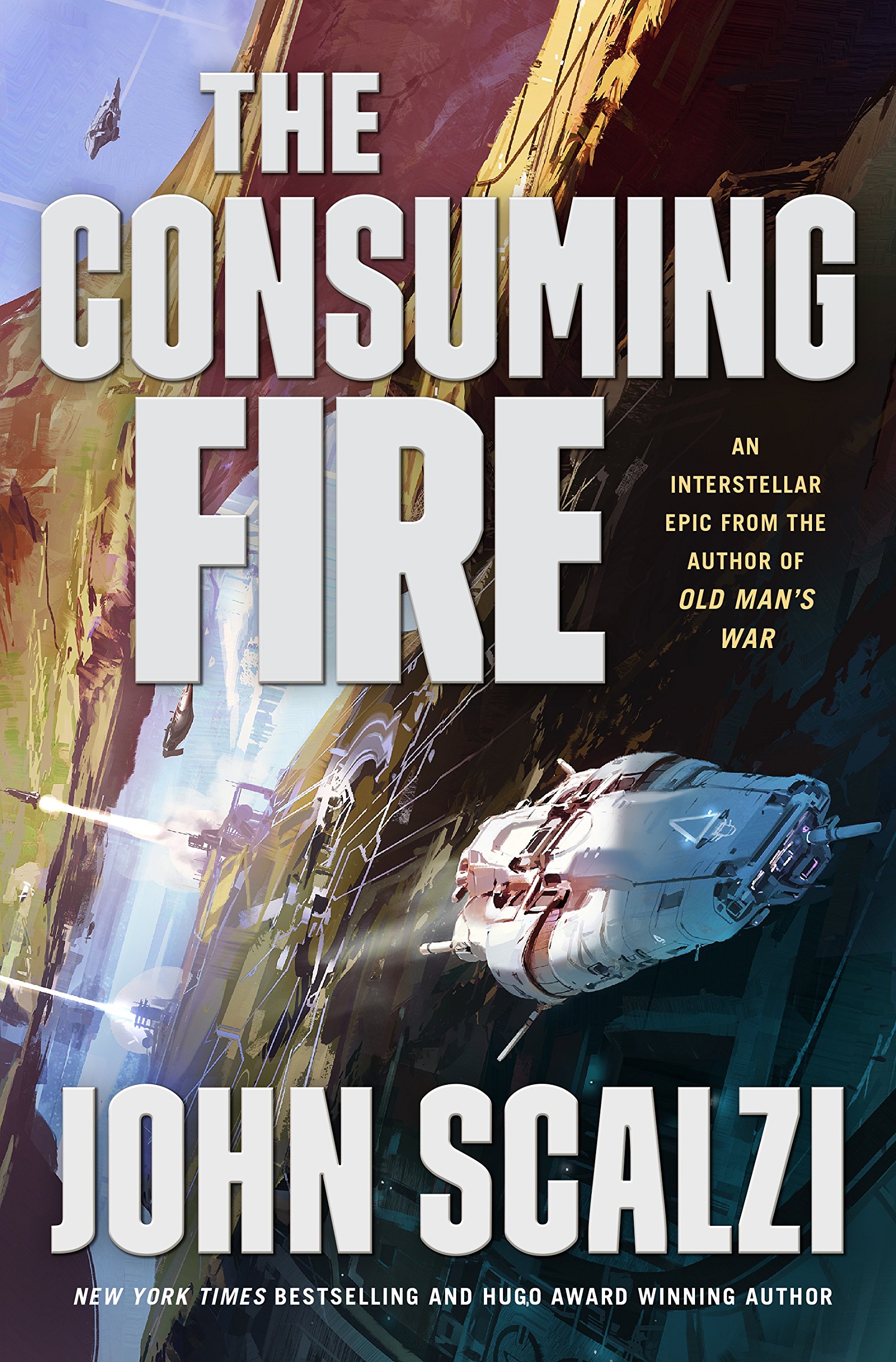
The Consuming Fire by John Scalzi


The story picks up pretty much where The Collapsing Empire leaves off. The three viewpoint characters, Cardenia, Marce, and Kiva return in this new volume.

Cardenia is becoming more comfortable in her role of Emperox and spiritual figurehead. She has decided to move forward with preparing the Interdependency for the Flow's collapse. There is doubt against her from her government, from the Wu clan, and from the church she leads.

Marce has found some new changes in the Flow's collapse. He teams up with another scientist who had been studying the Flow for House Nohamapetan. They determine there could be new, temporary Flow shoals that can pop up. One of these leads to a previously lost member of the interdependency. They convince Cardenia to let them launch an expedition.

Kiva Lagos has taken to the task of dealing with the Nohamapetan's dealings around Hub. Her efforts have turned up some rather elaborate skimming schemes. The Nohamapetan house is less than thrilled with her management of their functions. She also finds love!

There's a lot to enjoy with The Consuming Fire. Just like it's predecessor, it's an easy read that's fun to get into. Scalzi's story-telling is breezy and enjoyable. He keeps the chapters short enough to keep pulling the reader through the story. I found myself toting the book around to different appointments so I could read it in my free time. I loved the exploration aspect in this story. The idea that there's a lot more beyond the Interdependency is both exciting and intriguing.

A big theme of the story is the use of religion as a tool by the government. It definitely follows what Scalzi established previously. The use of religion as a political tool is historically undeniable. From the deification of the pharaohs to the creation of the Holy Roman Empire, history has shown time and again that religion and power go hand-in-hand.

But the way religion is handled is hard to swallow.

Personally, I think religion when properly handled can be a positive force in the world. It can give people a sense of belonging. It can also provide a strong mythology for people to use as a cornerstone for their identity. The brain is a story-making machine, and faith can provide a context for the personal story.

Let me point out: not everyone feels religious faith is necessary, and that's perfectly fine. I think Scalzi was trying to make points about the use of religion by government, not about faith as a whole.

But he doesn't present it in a concrete, understandable way. I don't know the tenants of the Interdependancy's religion after reading this book. I know it's a bit sanitary in practice; i.e., it doesn't normally trend towards the mystical. It promotes being a decent person. But I don't know how the faith actually provides believers with a higher understanding of their place in the cosmos.

The way Cardenia uses the church in her official capacity is an interesting move. She knows why the church was created, and seems to have some qualms about the morality of her role in it. But she doesn't hesitate to use it to prepare people for the imminent disaster. I liked that development; but I wish we could have seen some more personal wrestling with this idea. She makes up her mind to use a religious approach between books, and so we're only really seeing the aftermath.

I also had issues with the way the science was glossed over in the story. In several points, Marce was asked about particular details in the science. And he always said to the layperson that they wouldn't understand the math involved.

I don't typically like hard SF. Space opera and science fantasy are my jam. But I do want some more technobabble in my science fiction. I understand that pacing is a concern, but it doesn't have to be a lot. Just a bit. It's the paprika on the deviled egg.

The characters didn't have a lot of internal drama, either. It's a rather plot-based story. There are some romantic elements. It was easy to see from the last book that Marce and Cardenia would become an item. Box checked. But, for the most part, the characters remained static people. There wasn't a lot of personal growth. Just preparation for the upcoming Flow collapse.

Finally, it doesn't feel like this is a middle book of a trilogy. It feels like book two out of at least a six book story. The overall story moves a bit, but not significantly. I still feel like there's a lot more to learn about this world. That's not a bad feeling; I'm being entertained. I just want more.

The overall length of the book was just over 300 pages. It could have at least 150 more pages. I would have loved to see more world-building, more character development, and also more advancement of the plot. What we got was good, but The Consuming Fire could have been even better.

Thursday, October 18, 2018

Perdido Street Station by China Mieville

I enjoyed a lot of Perdido Street Station's parts -- particularly the first half of it. I loved the atmospheric nature of the story. I thought Mieville did a great job of immersing me into the world. I loved the early discussions of chaos theory. I enjoyed finding out about Lin and Isaac's relationship and their professional lives.

And then the story took a left turn. It went from a beautifully written character piece to a monster-hunting story. I don't mind thrillers at all, but I felt the change was too abrupt. Also, it took a far more uninteresting path. The set-up of the story I was interested in was the moral implications of helping a criminal regain what they lost due to punishment. What was delivered, while exciting, didn't have the same potential impact.

Also, I hated the fridging of Lin. It was unnecessary, and it deprived the reader from a really interesting story line. Instead of investigating the criminal side of New Crozuban from an outsider's perspective, her story line is dropped completely until the end of the book. At that point, she's not even given any further viewpoints.

I also find the implicit comparison between Yagharek and Lin unsettling. Yagharek's wings were removed for the crime of rape. Lin's headwings were removed as a way to threaten Isaac. I don't think it was intended, but it feels like the violator and the violated are thematically linked. There's almost a whiff of "Lin got what she deserved" from the association, which is totally not the case. It's a really sour note to end the book on.

All-in-all, I liked the writing and will look for other Mieville books to read in the future. However, I think Perdido Street Station suffers from being a second book. I fully expect that subsequent works will be better executed.