Showing posts with label 4 Stars. Show all posts

Wednesday, December 12, 2018

In the Vanishers' Palace by Aliette de Bodard

The world has been decimated by the Vanishers -- a race of aliens who came and exploited the world and then disappeared.

Now, humanity lives in the vestiges of a world created in their image. Life isn't easy. Due to the power vacuum the Vanishers left behind, society has fractured down into small villages. Unknown, new diseases ravage the population.

Fortunately, there is one individual who is helping humanity. The Vanishers left one of their servants behind: the dragon Vu Côn. She walks the earth, trying to make things better for those left behind. Normally, if she helps heal someone, she takes them as her own. Instead of complying to this practice, Yên's village makes a switch. They trade Yên, a failed scholar, instead.

Fortunately, Vu Côn has need of a scholar. She has two children at home in the Vanishers' palace. A scholar is exactly what she needs. So Yên goes to live in the Vanishers' Palace.

On her blog, de Bodard described this book as a story she wrote for herself. She had decided to write a f/f re-telling of Beauty and the Beast, with a mythical Vietnamese setting. It really works perfectly, for several different reasons. First, you can tell that the story is a labor of love. From the subject matter to her decision to self-publish, de Bodard made choices that allowed the story to be what she wanted it to be.

I really admire that decision. We got a lovely little work that feels familiar and fresh at the same time. Also, I think it does a great job of being daring. If de Bodard had focused on writing a book that would have been friendly to publishers, the work would not have been so strong to it's vision.
As I was reading, I kept confronting a singular question. What does the word "vertiginous" mean? It was used at least six different times to describe the palace. Normally, I can understand an unfamiliar word from the story's context, but this time I was puzzled.

At first I thought it was talking about a deep, watery green. Which shows a bit of personal prejudice. I tend to associate Asian dragons with water, Probably because of sources like Chinese dragon mythology. Miyazaki's river dragon, Haku, from Spirited Away also influences my perspective.

The word actually has a more apt meaning. According to Merriam Webster, it's characterized by vertigo or dizziness. It can also mean inclined to frequent, pointless change. 

This definition makes a lot of sense with the description of the Vanishers: an alien race who was  fearsome and unfathomable. It was a nice twist on expectations. I was expecting a fantasy based in mythology, but the Vanishers are more akin to the pantheon of the Cthulhu Mythos. 

Vu Côn, as the Beast analog, was a particularly fascinating character. She was a servant of the Vanishers that got left behind. She feels obligated to the destroyed world that her overlords left behind. Instead of being a Beast trapped by a curse, Vu Côn is motivated by a sense of responsibility. She is seen as a Beast because her motivations aren't clearly understood. 
 
Her lot is particularly poignant when you think about the way people treat her. Afraid of the dragon, they don't treat her like a person. They see her as someone to be feared. Vu Côn doesn't want to be ostracized in this way, but she accepts it as a form of personal atonement for the deeds she did. 
 
In a similar way, Yên is an outsider. She is interested in academics, but isn't good enough to go to the academy. She can't find her purpose in the village, but feels tied there by familial obligation. It is only with another outsider that she can accept who she is and find fulfillment. 
 
In the Vanisher's Palace isn't a long read, but it is well done. If you're looking for a different take on fairy tales, or for a lesbian love story with a great setting, I highly recommend it.

NOTE: I purchased this novel via pre-order. But I also received a copy of it through NetGalley.

Thursday, December 6, 2018

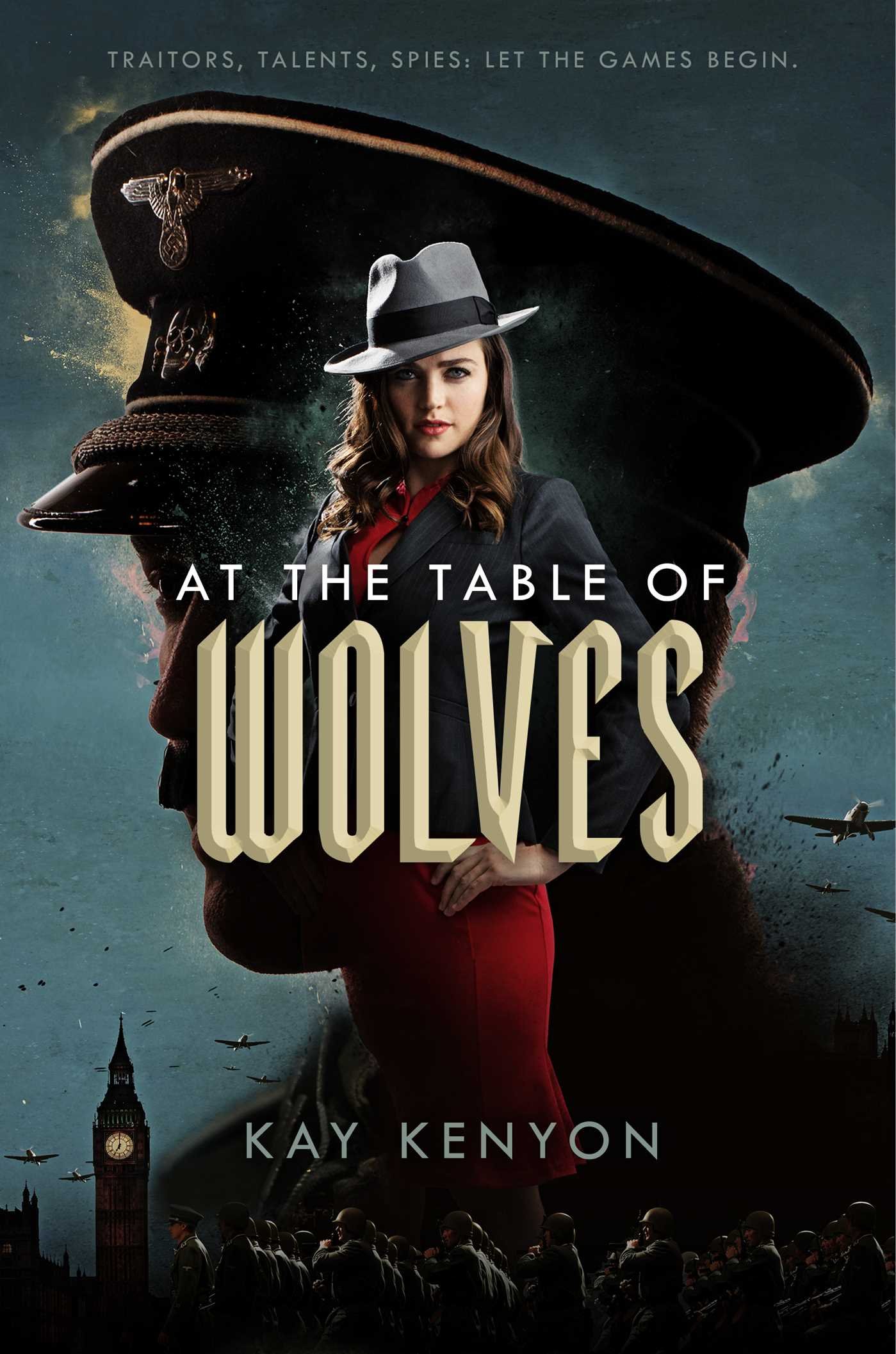
At the Table of Wolves by Kay Kenyon

In 1936, Germany's invasive streak is starting to become more noticeable. Weeks earlier, Rhineland was taken. While most of Europe is questioning what to do, England hasn't officially taken a position. But, of course, their espionage teams have begun monitoring for a Jerry invasion. 

Since the end of World War I, a new resource is available: Talents. It's not entirely clear why, but supernatural abilities have begun to bloom, sometimes in the most unexpected people.

Kim Tavistock is one of those people. A British/American dual citizen, she has returned to her father's homeland.  Her career as an investigative reporter in America has collapsed, and she's looking for a way to put her skills to use. Her Talent is spill; people share private, personal information with her. Just the perfect ability for a spy to have.

This book has a great story, but it's far less action-packed than what I expected. I think that was due to the cover. It's got an imposing, tense air. Those planes flying across bring up mental images of the bombing of London. The portrait of Kim is reminiscent of Hayley Atwell as Agent Carter. The promo copy on Simon and Schuster's website actually name checks Agent Carter along with Tinker Tailor Soldier Spy. I was expecting more behind-the-lines burglary and espionage flavored by superpowers.

Instead, the book has a high amount of social interaction, making the le Carré comparison more apt. Many of the important scenes are set in high society countryside weekends and fancy luncheons. The crux of information gathering in the story is gossip. Due to her Talent, Kim excels at this. Kenyon makes a fascinating choice, though, by making Kim uncomfortable with her ability.  She has no issues with her former role as an investigative reporter; but she wants people to like her for who she is. Kim doesn't want to betray people's trust, even unintentionally.

A major theme of the book is the dangers of a spy's life. By dint of the craft, one can't share information with those close. Kim isn't the only one who faces this issue. Her father, Julian, is a spy as well. Unlike Kim, Julian is working for H.R.M.'s government. The conflict between these two spies is at the crux of the story. They've been estranged for years. Now, both want to develop a closer relationship with each other. However, they each feel their secrets are too insurmountable. Kenyon is familiar with the theme of daughter/father conflict. It's a huge driver in her epic science fantasy series, The Entire and the Rose. It's not surprising to see her return to it in The Dark Talents.

One thing I particularly appreciated about At the Table of Wolves was the examination of modern events of the time. It's easy to look back at WWII and draw clear, black-and-white ideological lines. Kenyon captures the confusion of the time, though. A lot of people around the world thought that Hitler wasn't so bad. Even King Edward VIII (who reigned from January to December 1936) had pro-Nazi tendencies. After his abdication, Edward and his wife actually visited Hitler in Germany, and there were numerous rumors. Early in the book Kim mistakenly believes that her father is actually a supporter of Hitler, describing him as "something of a Nazi."

While the book is largely well done, there are a few flies in the ointment. The largest is the written use of accents in the story. The Tavistocks, being landed gentry, have servants. Their accents are thick and hard to read. It comes down to personal taste, but I have a hard time reading accents as they're written. It looks awful on the page. Also, it immediately hearkens back to the first time I saw it done -- the moles of Redwall. If it didn't make me think immediately of a children's book, I may be more lenient.

Overall, though, the story is breezily written, and is easy to follow. As mentioned before, the intrigue is a bit low-key compared to expectations, but it's very well paced and enjoyable.

Wednesday, November 28, 2018

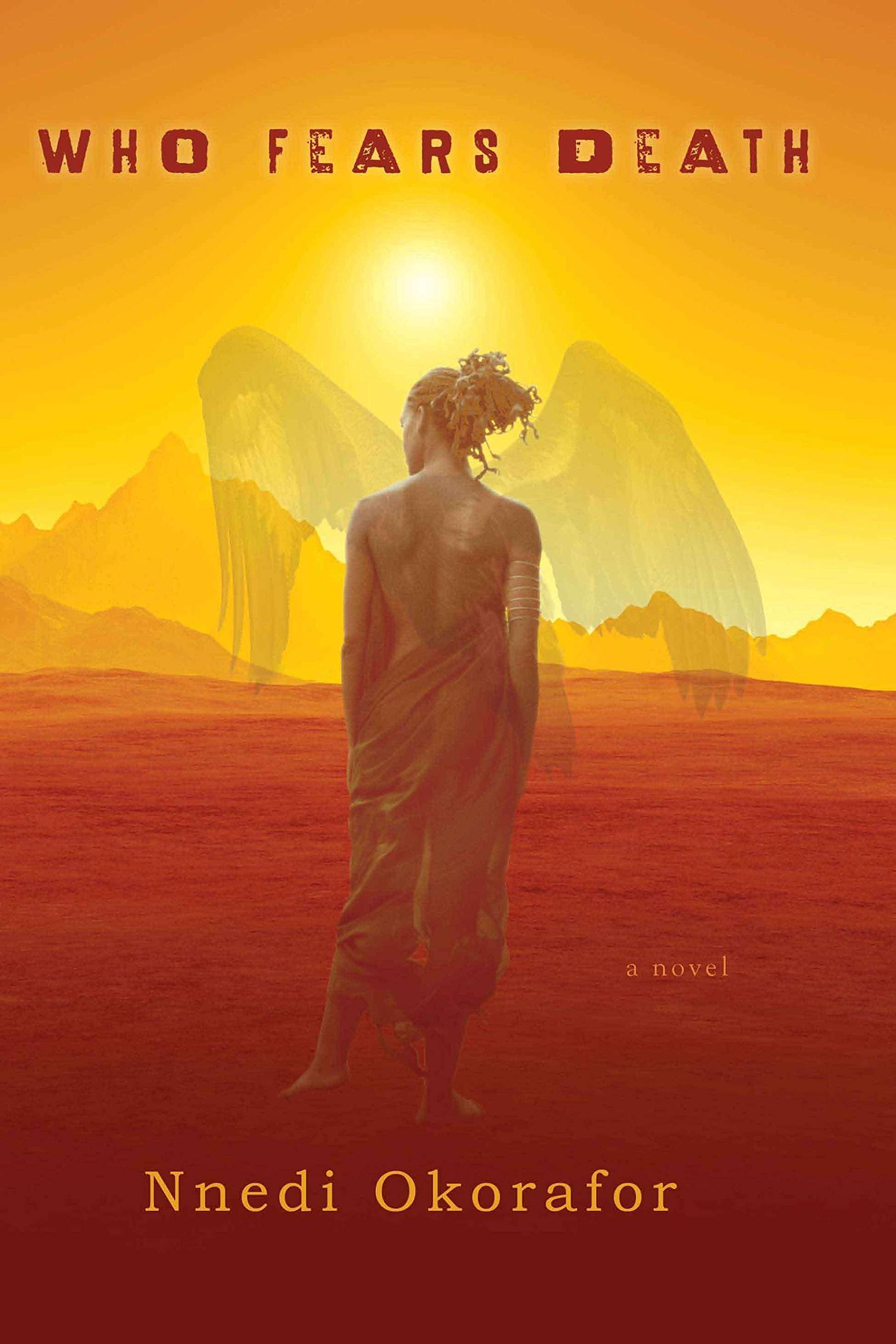
Who Fears Death by Nnedi Okorafor

Who Fears Death is the story of a young woman named Onyesonwu.  It takes place in a future, post-apocalyptic Sudan. Magic is real, and  coexists with legacy technology.

Onyesonwu is a child of interracial rape, an Ewu.  As a result of this heritage, her skin is the color of sand and she  immediately stands out in her culture. Her name translates as "who  fears death?"

The story is a rather character-driven  journey. The stakes are incredibly personal. Onyesonwu's mother's people  are the Okeke. The Nuru, her father's people, are invaders who have  subjugated many Okeke villages.

Okorafor pointed to this article on the Darfur crisis as inspiration. Onyesonwu's father, Daib, is a particularly nasty character. He acts as the book's main villain. For much of the story, she tries to reject that he is her father.

A large part of the story deals  with confronting her place in society and what it means to be Ewu. As she grows older, Onyesonwu  sees herself as a burden on her mother and stepfather. It's a struggle  that she pushes against throughout the entire story.

She  tries to follow her village's customs, even those her parents  disapprove of.  As an attempt to  increase her social standing within their community, . This creates a  temporary rift between her and her parents. But it provides a strong  bond with the others undergoing the ritual -- an important element to the story.

I liked this book quite a bit. I'm particularly biased towards first-person novels. In that regard, Who Fears Death  was already staged to meet my taste. Much of the book is in the first  person, from Onyesonwu's perspective. I loved getting into Onyesonwu's  views of the world. It was immediate, tense, and immersive.

It  is revealed that Onyesonwu is telling the story to a transcriber. so it becomes questionable how accurate the narration is. Which is great, because I like unreliable narrators, too. It  also changed the genre of the story from memoir to possible gospel.

The  ending left me feeling like Onyesonwu left an indelible change on her  world. She could be a possible messiah figure. It ended with enough ambiguity to  let the readers draw their own conclusion. But I would love to see how  Onyesonwu affected the two cultures presented in the future.

This  was Nnedi Okorafor's first novel for adults. She had written several  young adult novels before this one. She does a great job with the tone  of the book. I loved how it sucked me in with the beauty of the prose.  The chapter length is very well done. They read almost as well crystallized short stories.

While  this book was amazing, I wouldn't recommend it to everyone. The content  could definitely make some squeamish. I felt uncomfortable during certain portions. Particularly because I was reading out in public.

I realize that caveat is a large one for many people. But it is a good story that shines a light on feeling like an uncomfortable  in society.  Now more than ever, that's an important factor to think  about. If you are all right with the uncomfortable aspects  of the story, I highly recommend Who Fears Death.

Tuesday, November 13, 2018

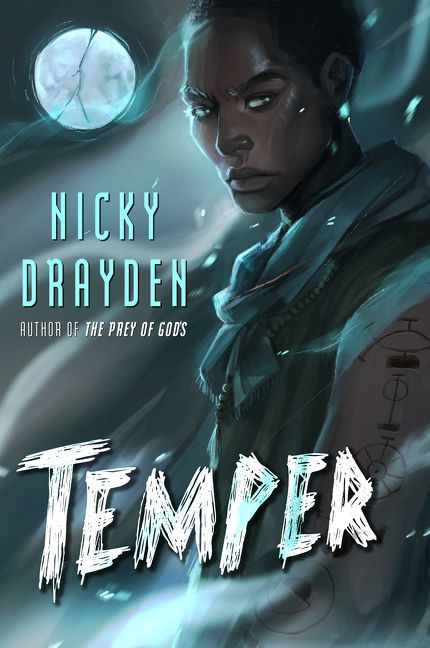
Temper by Nicky Drayden

Temper is about twin brothers, Auben and Kasim Mtuze. Set in a fictional analogue of southern Africa, they live in a society that is made up of primarily twins. As a coming-of-age ceremony, these twins are assessed and assigned a mixture of the seven vices.

Normally, it's common for the twins to split along a three to four ratio. Sometimes, it can be five to two. The Mtuzes are rare in that Auben has six and Kasim only has one.

Kasim has embraced his bad-boy lifestyle. He flirts with the girls. Classes are meant to be missed, right? Also, he isn't afraid to supplement his lifestyle with a little bit of theft.

But, as the year turns, Auben starts to hear voices. They're pushing him to go beyond petty  fun-seeking and move into more serious misdeeds. Also, he's starting to crave the taste of blood.

Overall, I really liked Temper quite a bit! This was Nicky Drayden's second effort, and I'm going to add her to my category of "to-read-upon-release."

First, I loved that the story was a standalone. There's nothing wrong with a series. But, sometimes, looking at the book store's shelves, I think that the stand alone speculative fiction novel is a lost art. It's nice to find a story that fits into less than four hundred pages.

I also liked the social structure of the world. Peoples' social status depended on how many vices they had. Since Auben had six, he wasn't looking at the rosiest of futures. Kasim was looking at the reverse. He expects to climb to a respectable position on the social ladder. Auben, though, can expect to live in a ghetto called a comfy.

Also, I liked the idea of a society of twins. There's a very specific world building reason that this happens that I won't get into here. But, in addition to the male/female paradigm, the twin effect has added the kigen gender, which was an interesting thing to think about.

The world of the story is going through an intense debate about religion and secularism. The two sides have very strongly drawn boundaries. Also, mechanical devices are verboten, due to cultural exploitation from machine-using conquerors.

The Mtuze's mother is strongly secularist, and she's raised her boys to be such as well. When they choose to explore religion as a means of understanding what's happening, she reacts strongly.

I love the sense of humor in the story. Auben revels in the funny. His uncle-in-law, Pabio, illustrates not-safe-for-work "childrens" books, such as an octopus with mouth-herpes. There are other examples, too, but some of them give away a bit too much of the story.

I was a little less thrilled with the use of language in the book. It's written in the first-person, present tense. No issues with the first-person voice -- I love it in general. It's just a touch jarring to read at first. Whenever I came back to the book, it took a few minutes to get back into the swing of the text.

Also, the chapters were really long. It was sometimes hard to find a good stopping point, particularly when I started dozing off in bed. If the chapter subsections had been a bit more clearly labeled, it would have been easier going.

Overall, though, those are some minor nitpicks. I highly recommend this for people interested in reading fantasy set in Africa (something sorely lacking at the moment), and also people interested in drama between family members.

Sunday, October 21, 2018

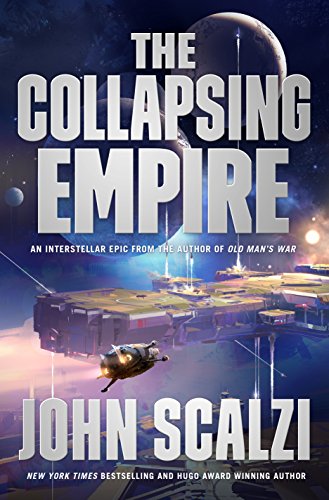
The Collapsing Empire by John Scalzi


The Collapsing Empire is the opening volume of Scalzi's latest space opera series. In this world, it is the far future. Humanity has spread to the stars in a vast empire which has existed for a millennium. There has been only one dynasty: that of the Wu family.

Faster than light travel isn't available in the most familiar sense. No hyperspace or warp speed. Instead, starships sail on a space/time current called the Flow. It doesn't take hours or even days to travel; rather, weeks or even months. There are specific points where ships can enter and exit the Flow, called shoals. 

At the beginning of the book, the Empire is in trouble. The Flow is beginning to change. It's no longer becoming accessible to humanity. Some people believe that it's reversing course. Others think something more dire is occurring.
 
According to an interview with NPR, some wondered if the title was a thinly veiled reference to the perceived fragility of the United States. Scalzi pointed out that he was reaching further back. 
In fact I did think very generally about the "golden age" of European exploration, roughly corresponding to the 15th through 17th centuries, in the sense that the empires that rose out of that era were wholly dependent on natural forces (wind, ocean currents, rivers) to move their ships and shape their destinies with regard to trade and exploration. We're so used to having at least some mechanical control of our travel that it's hard to put oneself back into a mindset where travel took months, not hours, and was not always a safe and predictable thing.  
So there was no one particular empire in our past I was borrowing from, but rather, a whole historical gestalt, and then only loosely. Please, historians, don't tell me all the things I'm getting wrong about the European age of exploration! I know. I KNOW.
I loved this approach! I've always found this time frame to be rather fascinating. And the tropes of the Age of Discovery were rather apt for a space opera. For example, trade monopolies. From a historic perspective, the East India Trade Company exerted tremendous power in Great Britain. 5% of all imports came from India, and passed through the Company's control at some point. 

Something similar occurs in this story.  The imperial Wu family is the dominant powerhouse. But they've allowed other nobility members to have their own franchise monopolies. For example, the Lagos family has control of all citrus fruits in the Interdependency.  

Scalzi's trademark snark seasons the story. He's never going to be one of my favorite stylistic writers. In general, I've always found his descriptions generic at best. But his biting sense of humor is a solid compensation. It makes the story easy to read, and I found myself moving through it at a quick clip. 

One area that the humor shines through is in the name of the ships. Scalzi has acknowledged that Iain M. Banks's Culture series were an inspiration. And sometimes a well-crafted homage fits into the tone of a book. Every time I heard about the Yes, Sir, That's My Baby and No, Sir, I don't Mean Maybe it made me smile. 

A word of warning to those who dislike profanity in their stories: this book is heavily layered with them. One character, Kiva Lagos, works in profanity like a proficienct master orator bent towards the obscene. While I found her funny, I can understand why others would easily tire of Kiva's... creative license.

All in all, I'd recommend The Collapsing Empire. It's funny, its easy to read, and it's creative by looking backwards to extrapolate forward. The second book in the series, The Consuming Fire, was a recent release. So expect my thoughts on that soon.