Showing posts with label 2018. Show all posts

Wednesday, December 12, 2018

In the Vanishers' Palace by Aliette de Bodard

The world has been decimated by the Vanishers -- a race of aliens who came and exploited the world and then disappeared.

Now, humanity lives in the vestiges of a world created in their image. Life isn't easy. Due to the power vacuum the Vanishers left behind, society has fractured down into small villages. Unknown, new diseases ravage the population.

Fortunately, there is one individual who is helping humanity. The Vanishers left one of their servants behind: the dragon Vu Côn. She walks the earth, trying to make things better for those left behind. Normally, if she helps heal someone, she takes them as her own. Instead of complying to this practice, Yên's village makes a switch. They trade Yên, a failed scholar, instead.

Fortunately, Vu Côn has need of a scholar. She has two children at home in the Vanishers' palace. A scholar is exactly what she needs. So Yên goes to live in the Vanishers' Palace.

On her blog, de Bodard described this book as a story she wrote for herself. She had decided to write a f/f re-telling of Beauty and the Beast, with a mythical Vietnamese setting. It really works perfectly, for several different reasons. First, you can tell that the story is a labor of love. From the subject matter to her decision to self-publish, de Bodard made choices that allowed the story to be what she wanted it to be.

I really admire that decision. We got a lovely little work that feels familiar and fresh at the same time. Also, I think it does a great job of being daring. If de Bodard had focused on writing a book that would have been friendly to publishers, the work would not have been so strong to it's vision.
As I was reading, I kept confronting a singular question. What does the word "vertiginous" mean? It was used at least six different times to describe the palace. Normally, I can understand an unfamiliar word from the story's context, but this time I was puzzled.

At first I thought it was talking about a deep, watery green. Which shows a bit of personal prejudice. I tend to associate Asian dragons with water, Probably because of sources like Chinese dragon mythology. Miyazaki's river dragon, Haku, from Spirited Away also influences my perspective.

The word actually has a more apt meaning. According to Merriam Webster, it's characterized by vertigo or dizziness. It can also mean inclined to frequent, pointless change. 

This definition makes a lot of sense with the description of the Vanishers: an alien race who was  fearsome and unfathomable. It was a nice twist on expectations. I was expecting a fantasy based in mythology, but the Vanishers are more akin to the pantheon of the Cthulhu Mythos. 

Vu Côn, as the Beast analog, was a particularly fascinating character. She was a servant of the Vanishers that got left behind. She feels obligated to the destroyed world that her overlords left behind. Instead of being a Beast trapped by a curse, Vu Côn is motivated by a sense of responsibility. She is seen as a Beast because her motivations aren't clearly understood. 
 
Her lot is particularly poignant when you think about the way people treat her. Afraid of the dragon, they don't treat her like a person. They see her as someone to be feared. Vu Côn doesn't want to be ostracized in this way, but she accepts it as a form of personal atonement for the deeds she did. 
 
In a similar way, Yên is an outsider. She is interested in academics, but isn't good enough to go to the academy. She can't find her purpose in the village, but feels tied there by familial obligation. It is only with another outsider that she can accept who she is and find fulfillment. 
 
In the Vanisher's Palace isn't a long read, but it is well done. If you're looking for a different take on fairy tales, or for a lesbian love story with a great setting, I highly recommend it.

NOTE: I purchased this novel via pre-order. But I also received a copy of it through NetGalley.

Tuesday, November 13, 2018

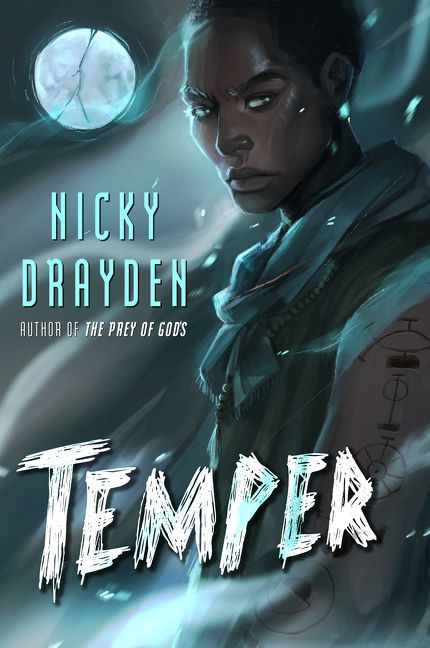
Temper by Nicky Drayden

Temper is about twin brothers, Auben and Kasim Mtuze. Set in a fictional analogue of southern Africa, they live in a society that is made up of primarily twins. As a coming-of-age ceremony, these twins are assessed and assigned a mixture of the seven vices.

Normally, it's common for the twins to split along a three to four ratio. Sometimes, it can be five to two. The Mtuzes are rare in that Auben has six and Kasim only has one.

Kasim has embraced his bad-boy lifestyle. He flirts with the girls. Classes are meant to be missed, right? Also, he isn't afraid to supplement his lifestyle with a little bit of theft.

But, as the year turns, Auben starts to hear voices. They're pushing him to go beyond petty  fun-seeking and move into more serious misdeeds. Also, he's starting to crave the taste of blood.

Overall, I really liked Temper quite a bit! This was Nicky Drayden's second effort, and I'm going to add her to my category of "to-read-upon-release."

First, I loved that the story was a standalone. There's nothing wrong with a series. But, sometimes, looking at the book store's shelves, I think that the stand alone speculative fiction novel is a lost art. It's nice to find a story that fits into less than four hundred pages.

I also liked the social structure of the world. Peoples' social status depended on how many vices they had. Since Auben had six, he wasn't looking at the rosiest of futures. Kasim was looking at the reverse. He expects to climb to a respectable position on the social ladder. Auben, though, can expect to live in a ghetto called a comfy.

Also, I liked the idea of a society of twins. There's a very specific world building reason that this happens that I won't get into here. But, in addition to the male/female paradigm, the twin effect has added the kigen gender, which was an interesting thing to think about.

The world of the story is going through an intense debate about religion and secularism. The two sides have very strongly drawn boundaries. Also, mechanical devices are verboten, due to cultural exploitation from machine-using conquerors.

The Mtuze's mother is strongly secularist, and she's raised her boys to be such as well. When they choose to explore religion as a means of understanding what's happening, she reacts strongly.

I love the sense of humor in the story. Auben revels in the funny. His uncle-in-law, Pabio, illustrates not-safe-for-work "childrens" books, such as an octopus with mouth-herpes. There are other examples, too, but some of them give away a bit too much of the story.

I was a little less thrilled with the use of language in the book. It's written in the first-person, present tense. No issues with the first-person voice -- I love it in general. It's just a touch jarring to read at first. Whenever I came back to the book, it took a few minutes to get back into the swing of the text.

Also, the chapters were really long. It was sometimes hard to find a good stopping point, particularly when I started dozing off in bed. If the chapter subsections had been a bit more clearly labeled, it would have been easier going.

Overall, though, those are some minor nitpicks. I highly recommend this for people interested in reading fantasy set in Africa (something sorely lacking at the moment), and also people interested in drama between family members.

Thursday, October 25, 2018

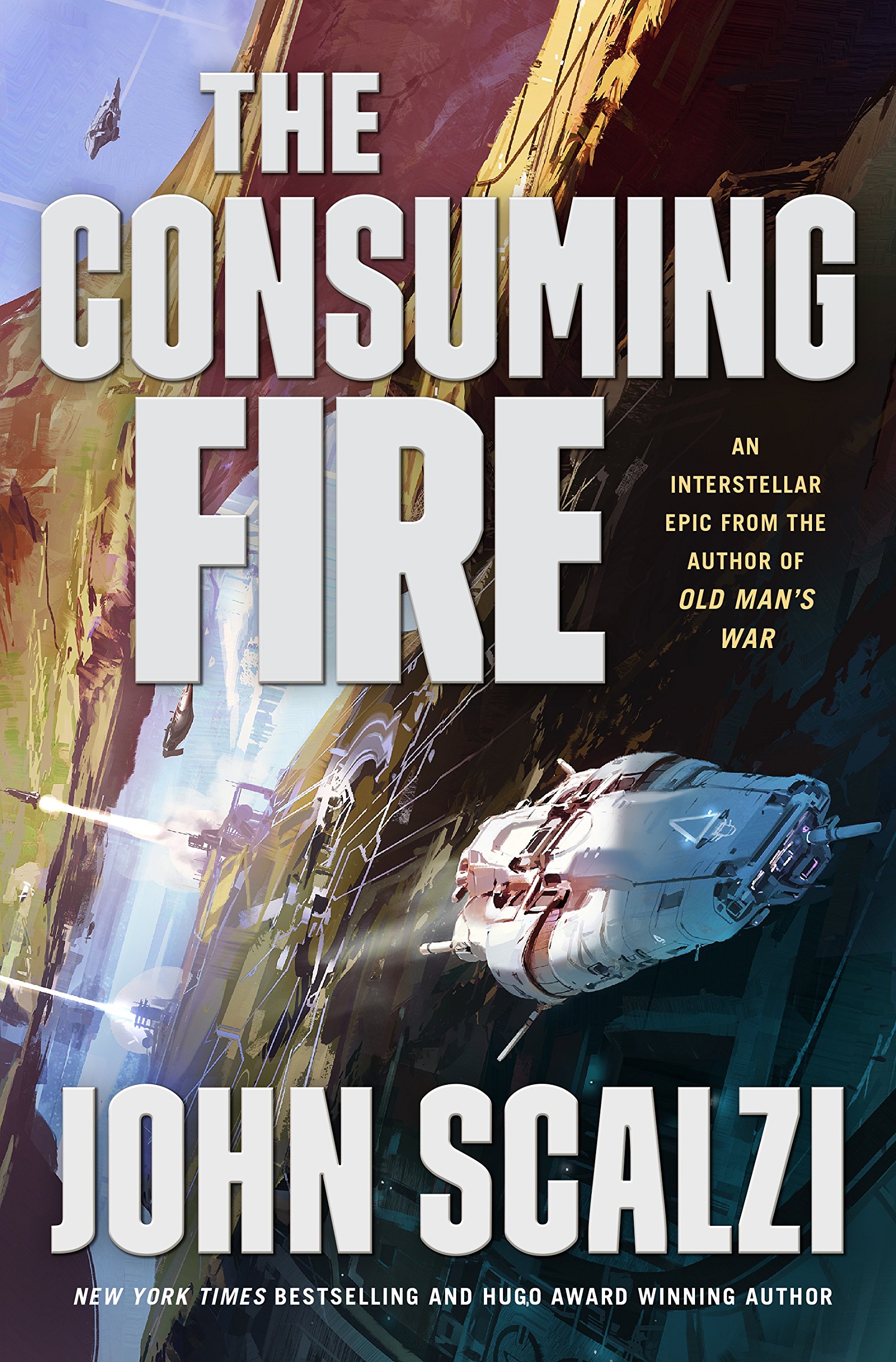
The Consuming Fire by John Scalzi


The story picks up pretty much where The Collapsing Empire leaves off. The three viewpoint characters, Cardenia, Marce, and Kiva return in this new volume.

Cardenia is becoming more comfortable in her role of Emperox and spiritual figurehead. She has decided to move forward with preparing the Interdependency for the Flow's collapse. There is doubt against her from her government, from the Wu clan, and from the church she leads.

Marce has found some new changes in the Flow's collapse. He teams up with another scientist who had been studying the Flow for House Nohamapetan. They determine there could be new, temporary Flow shoals that can pop up. One of these leads to a previously lost member of the interdependency. They convince Cardenia to let them launch an expedition.

Kiva Lagos has taken to the task of dealing with the Nohamapetan's dealings around Hub. Her efforts have turned up some rather elaborate skimming schemes. The Nohamapetan house is less than thrilled with her management of their functions. She also finds love!

There's a lot to enjoy with The Consuming Fire. Just like it's predecessor, it's an easy read that's fun to get into. Scalzi's story-telling is breezy and enjoyable. He keeps the chapters short enough to keep pulling the reader through the story. I found myself toting the book around to different appointments so I could read it in my free time. I loved the exploration aspect in this story. The idea that there's a lot more beyond the Interdependency is both exciting and intriguing.

A big theme of the story is the use of religion as a tool by the government. It definitely follows what Scalzi established previously. The use of religion as a political tool is historically undeniable. From the deification of the pharaohs to the creation of the Holy Roman Empire, history has shown time and again that religion and power go hand-in-hand.

But the way religion is handled is hard to swallow.

Personally, I think religion when properly handled can be a positive force in the world. It can give people a sense of belonging. It can also provide a strong mythology for people to use as a cornerstone for their identity. The brain is a story-making machine, and faith can provide a context for the personal story.

Let me point out: not everyone feels religious faith is necessary, and that's perfectly fine. I think Scalzi was trying to make points about the use of religion by government, not about faith as a whole.

But he doesn't present it in a concrete, understandable way. I don't know the tenants of the Interdependancy's religion after reading this book. I know it's a bit sanitary in practice; i.e., it doesn't normally trend towards the mystical. It promotes being a decent person. But I don't know how the faith actually provides believers with a higher understanding of their place in the cosmos.

The way Cardenia uses the church in her official capacity is an interesting move. She knows why the church was created, and seems to have some qualms about the morality of her role in it. But she doesn't hesitate to use it to prepare people for the imminent disaster. I liked that development; but I wish we could have seen some more personal wrestling with this idea. She makes up her mind to use a religious approach between books, and so we're only really seeing the aftermath.

I also had issues with the way the science was glossed over in the story. In several points, Marce was asked about particular details in the science. And he always said to the layperson that they wouldn't understand the math involved.

I don't typically like hard SF. Space opera and science fantasy are my jam. But I do want some more technobabble in my science fiction. I understand that pacing is a concern, but it doesn't have to be a lot. Just a bit. It's the paprika on the deviled egg.

The characters didn't have a lot of internal drama, either. It's a rather plot-based story. There are some romantic elements. It was easy to see from the last book that Marce and Cardenia would become an item. Box checked. But, for the most part, the characters remained static people. There wasn't a lot of personal growth. Just preparation for the upcoming Flow collapse.

Finally, it doesn't feel like this is a middle book of a trilogy. It feels like book two out of at least a six book story. The overall story moves a bit, but not significantly. I still feel like there's a lot more to learn about this world. That's not a bad feeling; I'm being entertained. I just want more.

The overall length of the book was just over 300 pages. It could have at least 150 more pages. I would have loved to see more world-building, more character development, and also more advancement of the plot. What we got was good, but The Consuming Fire could have been even better.

Thursday, October 11, 2018

Midnight Front by David Mack

I really wanted to like this one, but it failed to entertain.

I like the idea of WW2 fought with magic. But The Midnight Front tried to cram in too much. I think this book would have made a better series. There were a ton of characters, and they were all paper-thin. Even the main protagonists and antagonist. A series specifically about these characters would develop the character's motivations more. If they were likeable, I would have been more interested in the story.

There were several big set-piece moments that would have worked well as the climax of the story. For example, the battle of Normandy was the end of the book's second act. It could have easily been the culmination of a novel, especially considering the stakes presented.

Also, I didn't like the magic system in this one. It was one-dimensional and boring. The description of when characters used magic was in the following format: [Something cool] caused by [Specific Demonic Attribute]. The use of magic felt like a GURPS roleplaying game combining WW2 and Warlocks. I wish there were different sources of magic, too. I didn't like that
mages on both sides used demons. I guess I was pampered by Bitter Seeds by Ian Tregillis, where the magic had a more emotionally resonant source AND the Nazis got their powers from a different source than the Allies.

Also, the book doesn't have anything original to say about religion. It's a tired, lazy re-tread that is easy to see for miles off. For a book that has so much to do with the religion-inspired supernatural, it comes off as trite.

All-in-all, a disappointing read. It could have been so much better.