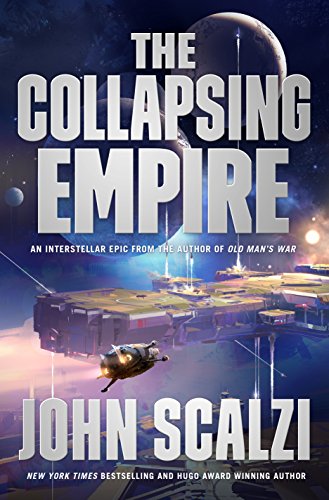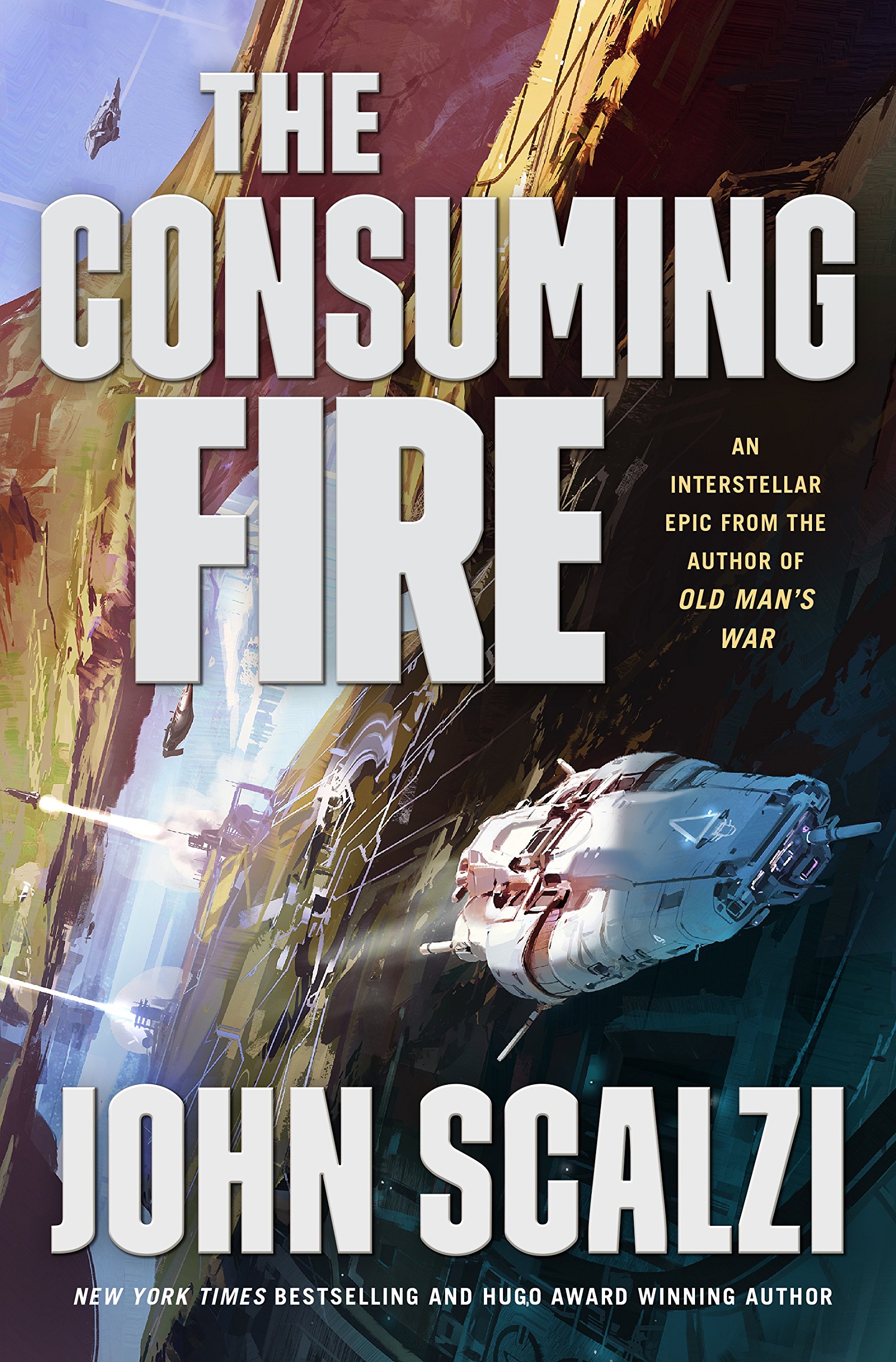
The story picks up pretty much where The Collapsing Empire leaves off. The three viewpoint characters, Cardenia, Marce, and Kiva return in this new volume.
Cardenia is becoming more comfortable in her role of Emperox and spiritual figurehead. She has decided to move forward with preparing the Interdependency for the Flow's collapse. There is doubt against her from her government, from the Wu clan, and from the church she leads.
Marce has found some new changes in the Flow's collapse. He teams up with another scientist who had been studying the Flow for House Nohamapetan. They determine there could be new, temporary Flow shoals that can pop up. One of these leads to a previously lost member of the interdependency. They convince Cardenia to let them launch an expedition.
Kiva Lagos has taken to the task of dealing with the Nohamapetan's dealings around Hub. Her efforts have turned up some rather elaborate skimming schemes. The Nohamapetan house is less than thrilled with her management of their functions. She also finds love!
There's a lot to enjoy with The Consuming Fire. Just like it's predecessor, it's an easy read that's fun to get into. Scalzi's story-telling is breezy and enjoyable. He keeps the chapters short enough to keep pulling the reader through the story. I found myself toting the book around to different appointments so I could read it in my free time. I loved the exploration aspect in this story. The idea that there's a lot more beyond the Interdependency is both exciting and intriguing.
A big theme of the story is the use of religion as a tool by the government. It definitely follows what Scalzi established previously. The use of religion as a political tool is historically undeniable. From the deification of the pharaohs to the creation of the Holy Roman Empire, history has shown time and again that religion and power go hand-in-hand.
But the way religion is handled is hard to swallow.
Personally, I think religion when properly handled can be a positive force in the world. It can give people a sense of belonging. It can also provide a strong mythology for people to use as a cornerstone for their identity. The brain is a story-making machine, and faith can provide a context for the personal story.
Let me point out: not everyone feels religious faith is necessary, and that's perfectly fine. I think Scalzi was trying to make points about the use of religion by government, not about faith as a whole.
But he doesn't present it in a concrete, understandable way. I don't know the tenants of the Interdependancy's religion after reading this book. I know it's a bit sanitary in practice; i.e., it doesn't normally trend towards the mystical. It promotes being a decent person. But I don't know how the faith actually provides believers with a higher understanding of their place in the cosmos.
The way Cardenia uses the church in her official capacity is an interesting move. She knows why the church was created, and seems to have some qualms about the morality of her role in it. But she doesn't hesitate to use it to prepare people for the imminent disaster. I liked that development; but I wish we could have seen some more personal wrestling with this idea. She makes up her mind to use a religious approach between books, and so we're only really seeing the aftermath.
I also had issues with the way the science was glossed over in the story. In several points, Marce was asked about particular details in the science. And he always said to the layperson that they wouldn't understand the math involved.
I don't typically like hard SF. Space opera and science fantasy are my jam. But I do want some more technobabble in my science fiction. I understand that pacing is a concern, but it doesn't have to be a lot. Just a bit. It's the paprika on the deviled egg.
The characters didn't have a lot of internal drama, either. It's a rather plot-based story. There are some romantic elements. It was easy to see from the last book that Marce and Cardenia would become an item. Box checked. But, for the most part, the characters remained static people. There wasn't a lot of personal growth. Just preparation for the upcoming Flow collapse.
Finally, it doesn't feel like this is a middle book of a trilogy. It feels like book two out of at least a six book story. The overall story moves a bit, but not significantly. I still feel like there's a lot more to learn about this world. That's not a bad feeling; I'm being entertained. I just want more.
The overall length of the book was just over 300 pages. It could have at least 150 more pages. I would have loved to see more world-building, more character development, and also more advancement of the plot. What we got was good, but The Consuming Fire could have been even better.